Offshore Call Centers: Pros, Cons & Key Insights



Key Takeaways:
- Offshore call centers can significantly reduce costs: Offshore outsourcing can cut customer support costs by 50–80% compared to onshore teams, mainly due to lower wages and operating expenses.
- Offshore teams enable true 24/7 customer support: Different time zones allow you to offer round-the-clock service without overtime pay or night-shift premiums, improving customer experience and response times.
- Offshore vs onshore is a trade-off, not a one-size-fits-all choice: Onshore offers stronger cultural alignment and communication, while offshore excels in cost efficiency, scalability, and extended coverage. The right model depends on your business priorities.
- Location selection directly impacts success: Each offshore region has distinct strengths:
- India: Best for cost efficiency and high-volume work
- Philippines: Strong English skills and customer service culture
- Mexico: Time-zone alignment and Spanish-language support
- Eastern Europe & Middle East: Nearshore advantages and technical expertise
- Offshore outsourcing works best as a strategic advantage: With the right country, partner, processes, and monitoring tools, offshore call centers can deliver high-quality service, cost efficiency, scalability, and measurable ROI
- Flowace addresses the core offshore management gaps: Flowace offers real-time agent and activity monitoring, performance dashboards and alerts, QA tools and analytics, data-driven reporting and much more
You want 24/7 customer support coverage, faster scaling and lower costs while hiring your employees. And you don’t want poor quality, data risks, or cultural mismatches that can damage your brand. Offshore call center outsourcing can deliver on all these goals if you choose the right country, partner, processes, and monitoring tools.
If you’re evaluating an offshore call center or offshore contact center, this guide gives you the real-world pros and cons to help you decide if offshore support is right for your business.
What Is An Offshore Call Center

An offshore call center (aka offshore contact center) is a customer support, sales, or telemarketing operation located outside your country, typically in lower-cost labor markets (e.g., Philippines, India, Latin America, Eastern Europe).
Agents in the offshore center handle inbound customer calls, outbound telemarketing campaigns, technical support, or other customer-facing work on behalf of your business.
Typically, you can outsource processes such as:
- Customer support & helpdesk
- Outbound telemarketing & lead qualification
- Back-office processing & order taking
- Multilingual support for international markets
Offshore Vs. Onshore Call Center Outsourcing
Call center outsourcing has become a strategic choice for many organizations. Two of the most common models are offshore and onshore call center outsourcing.
Onshore outsourcing involves hiring a third-party call center located within the same country as the business. Whereas, offshore outsourcing refers to contracting call center services in another country, often in regions such as India, the Philippines, or Eastern Europe.
Key Differences at a Glance
| Aspect | Onshore Outsourcing | Offshore Outsourcing |
| Cost | High due to wages and overhead | Low due to cheaper labor and operations |
| Communication | Very strong; native language and accent | Moderate to strong; accent may vary |
| Cultural Alignment | High; strong understanding of customers | Varies by country and training |
| Time Zones | Same time zone; easy coordination | Different time zones; enables 24/7 support |
| Scalability | Moderate and costly | High and flexible |
| Customer Perception | Often positive and trusted | Mixed; depends on service quality |
Cost:
If you choose onshore call center outsourcing, you will generally face higher costs due to higher wages, stricter labor regulations, and added expenses like office space and employee benefits.
Offshore outsourcing is more cost-effective for you, as lower labor and infrastructure costs help reduce overall spending while maintaining efficiency.
Communication:
With onshore call centers, you benefit from very strong communication because agents share your customers’ native language, accent, and communication style, reducing misunderstandings.
Offshore call centers offer moderate to strong communication, but you may occasionally notice accent differences or language nuances that affect clarity.
Cultural Alignment:
Onshore outsourcing gives you high cultural alignment, as agents understand local customs, social norms, and customer expectations, leading to more natural interactions.
Offshore outsourcing varies in cultural alignment; although agents are trained in cultural sensitivity, you may still observe subtle differences in behavior or communication.
Time Zones:
When you outsource onshore, you operate in the same time zone as your customers, making coordination simple and response times predictable.
Offshore outsourcing places you in different time zones, which can require planning but allows you to offer 24/7 customer support more easily.
Scalability:
Onshore call centers allow moderate scalability, but expanding usually requires higher investment and depends on local talent availability.
Offshore call centers give you high scalability, with access to large talent pools and flexible staffing that lets you adjust capacity quickly.
Customer Perception:
You’ll often see a positive customer perception with onshore call centers, as customers associate them with trust and higher service quality.
Offshore call centers tend to receive mixed perceptions. Some customers value faster service and extended hours, while others may have concerns about communication or service standards.
3 Reasons Why Companies Move to Offshore Call Centers
Companies increasingly turn to offshore call centers as a strategic solution to reduce costs, improve scalability, and deliver efficient customer support in a competitive global market.
Cost Savings Drive The Decision

When you operate onshore, a single customer service agent can cost you $30,000–$40,000 per year in salary, and close to $50,000 once benefits are included. In offshore locations like India or the Philippines, that same role typically costs you only $5,000–$8,000 annually.
For a 100-agent team, this can reduce your yearly spend from about $5 million to under $1 million—an 80%+ saving. Even after adding training, management, and technology costs, you can still save around 50–70%.
You Gain 24/7 Coverage Without Overtime Costs
Offshore teams allow you to support customers around the clock without paying overtime or night-shift premiums. Your offshore agents simply work their normal daytime hours, which align with your off-hours.
This “follow-the-sun” model gives your customers fast support across regions while avoiding employee burnout and excessive payroll costs.
You Access Much Larger Talent Pools
Offshore markets give you access to millions of skilled, English-speaking professionals. Countries like India and the Philippines produce large numbers of graduates with customer service and technical support experience, allowing you to scale your operations quickly without long hiring delays.
When you invest in proper training, quality call center monitoring or screen monitoring tools, standardized processes, and modern technology, offshore call centers can match or even exceed onshore performance.
Popular Offshore Call Center Locations: What You Need to Know
India
- Advantages: Lowest costs ($4,000–$6,000/agent/year), huge talent pool (300+ million English speakers), mature BPO industry, advanced technology platforms.
- Challenges: Large time zone difference with the US (9.5–10.5 hours ahead), varied accents, and cultural distance from Western customers.
- Best for you if: You need high-volume, routine tasks or back-office processes and can invest in training.
Philippines
- Advantages: Moderate costs ($5,000–$8,000/agent/year), 4+ million English speakers, strong cultural affinity with Western markets, customer-focused culture.
- Challenges: Smaller talent pool than India, infrastructure limitations in some regions, typhoon risks.
- Best for you if: You want customer service or tech support with strong English skills and cultural alignment.
Mexico
- Advantages: Same or similar time zones to the US, native Spanish speakers for Hispanic markets, easier travel for management, 30–40% savings vs. US onshore.
- Challenges: More expensive than India/Philippines, smaller talent pool.
- Best for you if: You want time zone overlap, closer management oversight, or support for Hispanic customers.
Eastern Europe (Romania, Poland, Bulgaria – Nearshore)
- Advantages: Aligned time zones for Europe, high English and technical skills, strong work ethic, 40–50% savings vs. Western Europe.
- Challenges: Higher cost than India/Philippines, smaller talent pool.
- Best for you if: You operate in Europe, need technical support, or value cultural proximity.
Egypt and Middle East
- Advantages: Low costs after India, time zones bridging Europe, Asia, and Africa, growing BPO sector with Arabic and English skills.
- Challenges: Less mature infrastructure, political and infrastructure risks in some areas.
- Best for you if: You serve Middle East or Arabic-speaking markets or want geographic diversification.
Best Practices for Managing Your Offshore Call Center Successfully
To get the most from your offshore call center, you need the right strategies. Here’s how you can manage your team efficiently and ensure high-quality service.
1. Start with a Pilot, Not a Full Launch
You shouldn’t move all your call volume offshore at once. Start small by shifting 10–15% of calls to a pilot team. This allows you to identify integration challenges, assess agent capabilities, and fine-tune training and processes.
Once the pilot succeeds, gradually scale to 30–50% of your volume, and only consider full migration after proving the model works. This phased approach dramatically reduces risk and prevents major disruptions.
2. Invest in Strong Training and Documentation
Your offshore team will succeed or fail based on the quality of training you provide. You need detailed operational playbooks, product modules, and customer service guides that clearly define how you expect agents to work.
Include culture and brand training so agents understand your customers and values, and provide recorded examples of excellent and poor calls. Document everything. What seems obvious to you may not be obvious to your offshore team.
3. Establish Clear Service Level Agreements (SLAs)
You must define your expectations clearly to avoid misunderstandings. Set SLAs for response times (e.g., 80% of calls answered within 20 seconds), resolution rates (e.g., 75–85% first-contact resolution), average handling time, quality scores, and schedule adherence.
Put these expectations in writing and tie them to compensation or penalties, so your offshore team knows exactly what success looks like.
4. Implement Real-Time Performance Monitoring
You can’t manage what you can’t see. Implement dashboards and monitoring tools that show live agent status, queue metrics, daily KPIs, and individual performance.
Use trend data to identify problems early, provide coaching in real time, and make data-driven staffing decisions. Real-time visibility helps you address issues before they affect your customers and proves ROI to stakeholders.
5. Use Productivity and Activity Tracking
Beyond call metrics, you need to track how your agents spend their time. Monitor application usage, task completion, and adherence to scheduled hours and breaks.
This prevents “pretend work,” ensures productivity, and helps you identify agents who may need coaching or support to meet expectations.
6. Create a Dedicated Onshore Liaison Team
Even with an offshore operation, you need a small onshore team to act as a bridge. These senior team members handle complex issues, escalations, and training while gathering feedback from the offshore team on process improvements.
A dedicated liaison team of 1–3 people can dramatically improve communication, alignment, and operational success.
7. Schedule Regular Communication and Feedback
Time zone differences make regular communication critical. Hold daily handoff meetings when shifts overlap to discuss issues and escalations.
Conduct weekly performance reviews to analyze the call center metrics and trends, monthly business reviews with offshore leadership for strategic planning, and quarterly planning sessions for volume forecasts and process updates. Document everything to ensure your team can participate asynchronously.
8. Implement Quality Assurance Systematically
Quality cannot be left to chance. Conduct daily QA sampling, use AI-powered speech analytics to monitor all calls, and score performance objectively using consistent rubrics. Provide individual feedback to agents and track quality trends over time.
A systematic QA process ensures high standards, identifies improvement areas, and helps your offshore team consistently deliver excellent service.
Top Challenges of Offshore Call Centers (And How to Overcome Them)
As you consider offshore outsourcing, recognizing the challenges early and preparing for them will determine whether your operation succeeds or struggles.
1. Language Barriers and Accent Issues
Even if offshore agents speak English, strong accents or grammar gaps can frustrate your customers, causing miscommunication and repeated issues.
How you overcome it:
- Screen language skills carefully with standardized tests.
- Invest in accent training or neutralization programs.
- Provide clear scripts and FAQs to guide conversations.
- Route complex or sensitive calls to onshore or native speakers.
2. Cultural Differences and Misunderstandings
Offshore agents may not grasp your brand voice, customer expectations, or culturally specific situations, which can create awkward interactions.

How you overcome it:
- Offer culture and customer-context training, not just product training.
- Share customer personas and real-life scenarios.
- Provide clear brand guidelines on tone, voice, and values.
- Have onshore teams review calls and coach offshore agents on nuances.
3. Time Zone Coordination and Delayed Feedback
Your offshore team works while your onshore team sleeps, delaying feedback and issue resolution.
How you overcome it:
- Use automated quality monitoring to flag issues immediately.
- Document feedback for asynchronous delivery.
- Implement “follow-the-sun” management with overlapping shifts.
- Use AI-powered QA to score calls and prep coaching notes for the next day.
4. Lack of Control and Visibility
You can’t directly see agent activity, protocol adherence, or service quality, making it hard to manage operations.
How you overcome it:
- Use real-time monitoring tools like Flowace to track activity and call metrics.
- Set up performance dashboards for key KPIs.
- Record calls and conduct daily QA sampling.
- Define SLAs clearly with expectations for response time, resolution, and quality.
5. Infrastructure and Reliability Risks
Offshore centers may face unreliable power, internet, or telecom systems, disrupting customer support.
How you overcome it:
- Vet infrastructure before signing contracts.
- Require redundancy: backup power, internet, and disaster recovery.
- Maintain onshore or nearshore backup coverage.
- Include business continuity clauses with penalties for downtime.
6. Hidden Costs and Budget Overruns
Beyond salaries, unexpected costs can include training, tech setup, management, QA, and onboarding travel.
How you overcome it:
- Request a detailed, itemized cost breakdown upfront.
- Build a 15–20% contingency into your budget.
- Negotiate fixed pricing for a set period.
- Track internal management costs for coordination and training.
7. Inconsistent Performance and Quality Drift
Initial performance may be strong, but quality can decline over time as focus diminishes.
How you overcome it:
- Conduct regular performance reviews with KPIs and call audits.
- Use analytics to detect quality drops early.
- Rotate agents and supervisors to maintain engagement.
- Provide ongoing coaching and skill development instead of one-time training.
How Flowace Solves the Offshore Call Center Management Problem
When you outsource to an offshore call center, a major issue you might face is the lack of visibility into the work being done. Traditional call center metrics (calls handled, average handle time, first-call resolution) tell you what happened, but not how it happened or whether quality is actually there. Most often, you get spreadsheets instead of real-time insights.
Or worse, you have no way to track whether agents are actually productive during their shifts.
Are they taking excessive breaks? Using time for non-work activities? Handling calls efficiently or just stretching them out?
Without this visibility, you can’t address performance issues until they become a crisis. But, Flowace provides the real-time visibility you need to monitor and optimize performance.
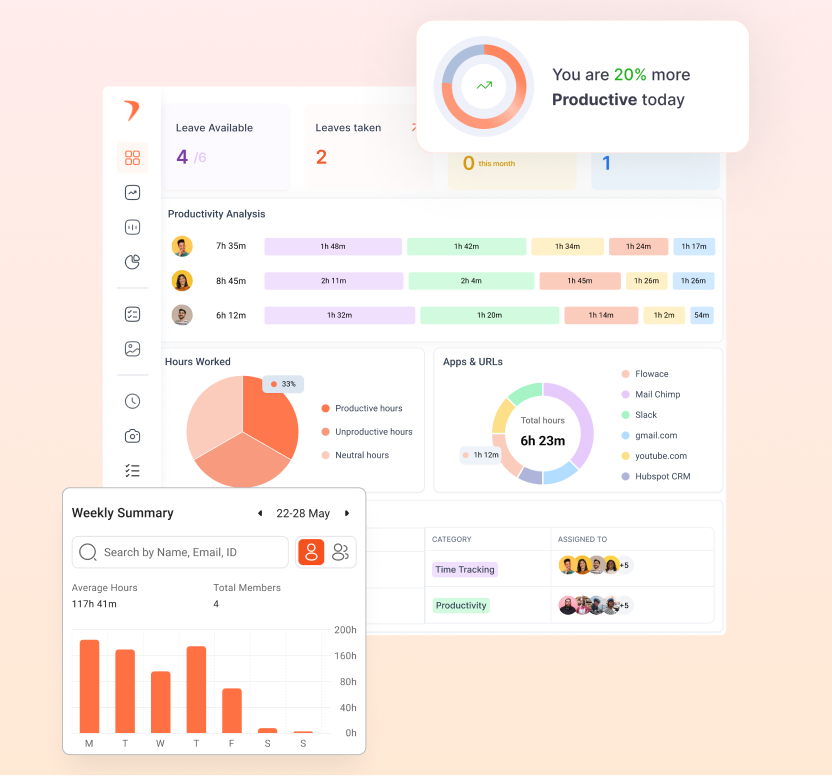
Flowace is an AI-powered employee monitoring tool that goes beyond traditional metrics. It gives you real-time visibility into every aspect of your offshore call center operations.
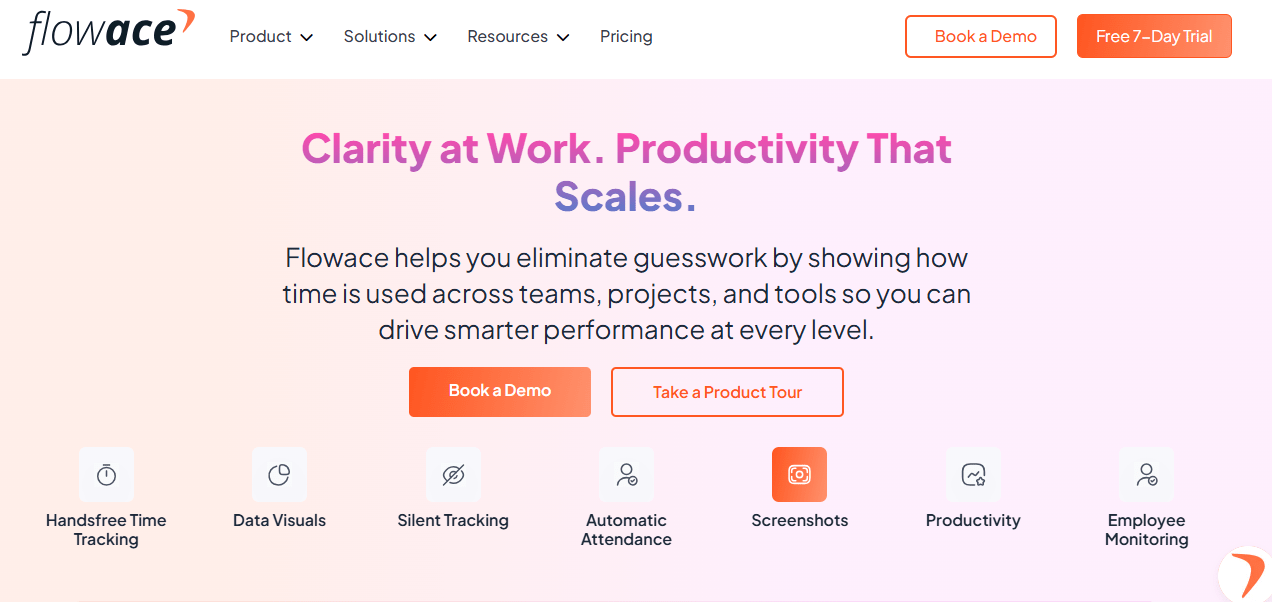
Key Features of Flowace:
- Real-Time Agent Monitoring: See exactly what your agents are doing during their shifts—calls handled, applications used, and active work time—so you can ensure productivity and accountability.
- Performance Dashboards: Track key metrics such as average handle time, first-call resolution, call quality scores, and schedule adherence on live dashboards. Spot trends and identify areas for improvement instantly.
- Activity Tracking: Monitor adherence, task completion, and time spent on various activities to prevent inefficiencies or “pretend work.”
- Quality Assurance Tools: Use call recordings, AI-powered speech analytics, and customizable QA rubrics to evaluate and improve service quality consistently.
- Automated Alerts & Notifications: Receive instant alerts when metrics fall below expected levels, so you can intervene quickly.
- Data-Driven Coaching: Provide targeted, actionable feedback to agents based on real-time performance data, boosting call center productivity and service quality.
- Reporting & Analytics: Generate detailed reports for stakeholders, proving ROI and giving you insights for long-term strategic planning.
With Flowace, you no longer have to guess what your offshore team is doing. You gain the visibility, control, and actionable data you need to optimize your call center workforce, improve customer satisfaction, and maximize ROI.
Final Thoughts
Offshore call center outsourcing can deliver significant benefits like cost savings, 24/7 support, faster scaling, and access to larger talent pools. Success depends on choosing the right location, partner, processes, and tools, while addressing challenges such as language barriers, cultural differences, time zone coordination, and quality control.
By following the best practices you can ensure your offshore operations run smoothly and deliver high-quality customer experiences.
Tools like Flowace take offshore management to the next level, giving you full visibility into agent activity, performance, and productivity in real time. With the right approach and technology, you can optimize operations, maintain control, and maximize ROI, turning your offshore call center into a true strategic advantage for your business.
See the difference real-time monitoring makes. Start your free trial or book a free demo with our experts to manage your offshore team like never before.