Flexible Work Schedules: Guide to Modern Workforce



Key Takeaways:
- Flexible work schedules shift focus from strict 9-to-5 office hours to outcomes, autonomy, and employee well-being.
- There are multiple flexible schedule types—compressed workweeks, flextime, remote, hybrid, job sharing, staggered shifts, ROWE, seasonal schedules, and desk sharing—each with unique benefits and challenges.
- When implemented well, flexible work schedules improve productivity, reduce turnover, lower commuting stress, and support real-life needs like childcare, health, and education.
- Poorly managed flexibility can create problems: blurred work–life boundaries, coordination headaches, workload imbalance, and fairness concerns.
- Clear written policies, outcome-based performance metrics, and strong communication are essential to making flexible work sustainable.
- Managers need training to shift from time-based oversight to results-based leadership and to maintain fairness across different schedule types.
- Visibility into who is working on what, and when, is the biggest operational challenge in flexible and remote environments.
- Tools like Flowace provide automatic time and task tracking, helping teams maintain accountability without invasive micromanagement.
- A pilot-first approach—testing flexible schedules with selected teams, tracking outcomes, and iterating—reduces risk and improves adoption.
The old 9-to-5, five-days-a-week grind no longer defines modern work. Today’s workers demand flexibility. Today, 88% of employees consider schedule flexibility very important.
Companies that meet this demand by offering remote work, flextime, and other flexible options generally see much lower turnover and higher productivity.
But flexibility only succeeds if handled correctly. When everyone sets their own hours or location, managers lose the old visibility. You may not know who is working at any given hour, when key tasks get done, or if workloads have become uneven.
This guide covers the major types of flexible work schedules in use today, with real-world examples and data. We explain how each model works, highlight its benefits and challenges, and share best practices for implementation.
What Is a Flexible Work Schedule?

A flexible work schedule is any arrangement that lets employees control when and/or where they work, instead of strictly following a fixed 9-to-5 office shift. It shifts the focus from “hours logged” to results achieved.
In practice, flexible schedules might mean adjustable start/end times, compressed weeks, work-from-home days, or other nontraditional models.
The key characteristics include:
- Employee choice: Individuals have autonomy over at least one aspect of their work timing or location.
- Results-orientation: Success is measured by deliverables and goals, not by face time.
- Clear expectations: Even with flexibility, there are usually defined “core” hours or deadlines so teams stay coordinated.
- Reduced friction: By removing strict hours or commuting, flexible schedules help employees balance personal commitments, leading to better morale and health.
The COVID-19 era may feel distant, but it permanently reshaped how people view work and jobs. Remote and hybrid work are now commonplace.
Beyond attracting workers, flexible policies tend to reduce absenteeism and lower stress as well. For example, hybrid workers report taking fewer sick days after shifting to a flexible model.
But poorly implemented flexibility (with vague rules or uneven policies) can hurt coordination and fairness. The key is to balance autonomy with accountability.
Types of Flexible Work Schedules: A Complete Overview
From compressed workweeks and flextime to remote and hybrid models, flexible schedules are no longer perks reserved for a few progressive companies. They have become a strategic advantage for attracting talent, improving productivity, and supporting work–life balance across industries.
Let’s break down the most common types of flexible work schedules here:
1. Compressed Work Week
A compressed work week lets you complete full-time hours in fewer days, giving you longer stretches of time off without reducing your total workload. Instead of working five standard days, you work longer hours across three or four days.

Common versions include:
- 4/10 schedule: You work four 10-hour days (for example, Monday to Thursday), with one weekday off every week.
- 9/80 schedule: You work eight 9-hour days and one 8-hour day over two weeks, earning every other Friday off.
- 3-day weekend model: You work longer daily hours so that every week includes a guaranteed three-day weekend.
Compressed work weeks give you longer, uninterrupted breaks, which can significantly improve your work–life balance.
Benefits:
Studies and real-world experiments support this: when Microsoft Japan tested a four-day workweek, employees became 40% more productive and took 25% fewer unscheduled days off. An extra day off each week also means lower commuting costs, a smaller carbon footprint, and reduced office expenses for employers.
Challenges:
Working 10 or more hours a day can be demanding. Without proper boundaries, it may lead to fatigue or burnout. Collaboration can also become more complex if team members take different days off, and customer-facing roles may struggle to align coverage with extended weekends.
Best for:
This model works best if you need long, uninterrupted blocks of time, such as in development, design, research, or creative roles. It also suits organizations looking to cut office and commute costs.
2. Flextime
Flextime gives you the freedom to choose when your workday starts and ends, as long as you complete your full weekly hours and meet expectations. Instead of following a fixed schedule, you tailor your working hours to match your energy levels, personal commitments, and lifestyle.
Common variations include:
- Core hours model: You’re required to be available during fixed “core” hours (for example, 10 a.m. to 3 p.m.), but you can start earlier or finish later outside that window.
- Fully flexible schedule: There are no mandatory office hours at all. As long as you complete your required hours (such as 40 per week) and deliver results on time, you can work any schedule that suits you.
- Split shifts: You work in two separate blocks (for example, 7 a.m.–12 p.m. and 4 p.m.–8 p.m.), with a longer break in between. This works well if you need to cover multiple time zones or manage personal responsibilities during the day.
For instance, you might choose to work from 7 a.m. to 3 p.m. to avoid peak-hour traffic, or from 11 a.m. to 7 p.m. if you perform better later in the day. As long as you overlap during core hours (if required) and complete your weekly quota, your schedule remains flexible.
Benefits:
Flextime allows you to work when you’re most productive. It also reduces commuting stress and makes it easier to handle personal errands without taking formal time off. A study found that the ability to adjust one’s work schedule increased job satisfaction by nearly 60%.
Challenges:
This model relies heavily on trust and self-discipline. If everyone follow-s a different schedule, coordinating meetings can be difficult. Without clear boundaries, you may also find it harder to switch off, leading to an “always-on” work culture.
Best for:
Flextime works best if you do knowledge-based or collaborative work that can be done asynchronously (software development, marketing, or content creation). It’s ideal for high-trust teams, distributed workplaces, and anyone with changing personal schedules.
3. Remote Work
Remote work allows you to do your job outside a traditional office. Be it from home, a coworking space, a café, or anywhere with a reliable internet connection.

Common models include:
- Fully remote: You rarely (if ever) go into a physical office, aside from optional team meetups.
- Part-time remote: You work from home on certain days or hours and come into the office the rest of the time.
- Location-flexible: You can work from anywhere, even internationally, as long as you meet availability and performance expectations.
Benefits:
You can eliminate commute time, saving you time and money. Remote workers often report lower daily expenses and greater control over their work environment. It also enables companies to hire globally, while employees frequently report higher productivity and fewer interruptions.
Challenges:
Less face-to-face interaction can make collaboration, onboarding, and mentorship harder. Without clear boundaries, you may struggle to disconnect at the end of the day. Isolation is another risk, especially if communication and inclusion aren’t handled intentionally.
Best for:
Remote work is ideal if you have a digital-first role such as software development, design, writing, sales, or administrative work. It suits self-motivated professionals and organizations that embrace distributed or global teams.
4. Hybrid Work Schedules
Hybrid work lets you split your time between working remotely and coming into the office. It combines the flexibility of remote work with the collaboration and connection of in-person days.
Common patterns include:
- Split-week (2/3): You work part of the week in the office and the rest remotely.
- Alternating weeks: One week is fully in-office, the next fully remote.
- Core office days: You’re expected in the office on specific days, with remote flexibility on others.
- Flexible office days: You choose which days to come in based on work needs.
- Role-based hybrid: Your in-office time depends on your role (for example, client-facing roles come in more often).
In this method, your employer defines a hybrid policy. You then plan your schedule around it, coordinating with your team so key meetings and collaboration happen face-to-face when needed.
Benefits:
Hybrid work gives you the best of both worlds: meaningful in-person collaboration without sacrificing flexibility. It often improves work–life balance, boosts engagement, and helps companies retain talent
Challenges:
Hybrid schedules require coordination. If not managed carefully, you may experience miscommunication, uneven visibility between remote and in-office employees, or unclear expectations. Without planning, offices can also feel underused on certain days.
Best for:
It’s ideal if you work in creative, strategic, or mixed-function roles and for companies shifting away from fully in-office models toward flexibility.
5. Job Sharing
Job sharing allows you to split a full-time role with another employee. Together, you cover the responsibilities and hours of one position, often by each working part-time (for example, 20 hours each to cover a 40-hour role).
- You and your job-sharing partner coordinate schedules and divide tasks.
- You might split the week between you or own specific projects.
- Pay and benefits are prorated based on the hours you work.
Benefits:
Job sharing lets you stay in the workforce without committing to full-time hours. It is ideal if you’re a parent, student, or transitioning toward retirement. You gain a built-in backup, reduce burnout, and benefit from shared knowledge and perspectives in one role.
Challenges:
Success depends on clear communication and trust. Without strong coordination, tasks can be missed or duplicated. Others may also be unsure who to approach unless responsibilities are clearly defined.
Best for:
Job sharing works well if you have a role where work can be divided cleanly and doesn’t require constant full-time coverage.
6. Staggered Schedules
Staggered schedules let you start and end your workday at different times than your colleagues, spreading coverage across longer business hours or even 24/7.
In this method, you will be assigned a specific shift (for example, 7 a.m.–3 p.m., 10 a.m.–6 p.m., or 2 p.m.–10 p.m.). In some setups, you rotate through shifts weekly or monthly. In others, teams permanently work early or late hours to extend coverage without overtime.
Benefits:
Staggered schedules provide longer business coverage while reducing the number of people on-site at once. If you prefer working early mornings or late evenings, this model can better match your natural rhythm and boost productivity. It also reduces peak-hour commuting and workplace crowding.
Challenges:
Managing shifts can be complex, and irregular or night hours may be tiring. With limited overlap, you might experience less team interaction. Some shifts may also come with extra expectations or premiums.
Best for:
This model works best if you are in industries that require extended or continuous coverage, such as healthcare, customer support, retail, manufacturing, or facilities management.
7. Results-Only Work Environment (ROWE)
A Results-Only Work Environment gives you complete freedom over when and where you work. As long as you deliver agreed-upon results, you will not be judged by when you log in or where you work from.
There are no fixed schedules or locations. You choose your own working hours and environment, while managers evaluate you based on clear goals, deliverables, and performance metrics.
Benefits:
ROWE offers maximum autonomy. If you are a self-starter, it lets you work at your peak productivity times, reduces micromanagement, and builds trust. When done right, it can significantly boost engagement and performance.
Challenges:
This model depends on well-defined, measurable goals. Without them, expectations can become unclear, leading to underperformance or overwork. Collaboration can also be harder if everyone works unpredictable hours, and not all teams or managers are ready for such a mindset shift.
Best for:
ROWE works best if you are in a highly autonomous role with measurable outputs such as sales, consulting, or project-based creative work. It suits organizations with a strong performance culture and leaders who truly evaluate success by results.
8. Seasonal / Project-Based Schedules
Seasonal or project-based schedules adjust your working hours based on business demand or project intensity, rather than keeping them fixed year-round.
During peak seasons or major project phases, you may work longer hours or extra days. When demand slows, your hours are reduced, or you’re given additional time off. For example, you might work extended days during a launch or tax season, then shift to lighter schedules afterwards.
Benefits:
This model aligns your workload with real business needs. You can plan time off during predictable slow periods, and the built-in recovery time helps prevent long-term burnout when managed well.
Challenges:
Fluctuating hours can make personal planning harder, especially for childcare or finances. Extended peak periods may also require overtime and can increase fatigue if not carefully balanced.
Best for:
Seasonal and project-based schedules work best if you are in industries with predictable demand cycles, such as accounting, retail, tourism, or consulting, or in project-driven environments with clear delivery phases.
9. Desk Sharing
Desk sharing means you don’t have a permanently assigned desk. Instead, you reserve workspace only on the days you come into the office. While it’s more about space than time, it supports flexible work schedules.

On in-office days, you book a desk or room, usually through an app and clear it at the end of the day so others can use it. This is often paired with hybrid or remote work, where you come in only when needed.
Benefits:
This setup reduces unused office space and supports a remote-friendly culture. You use the office intentionally, and shared spaces stay cleaner and more efficient.
Challenges:
Without a personal desk, you may feel less connected to your team. Reliable booking systems and coordination are essential, or seating and collaboration can become frustrating.
Best for:
Hoteling works best if you are in a hybrid or remote-first organization where office attendance is occasional, and space optimization is a priority.
Benefits of Flexible Work Schedules
As work becomes more outcome-driven flexibility empowers you to work in ways that align with your energy, responsibilities, and life outside the office. Flexible schedules yield big wins for employees and employers alike:
Better Work–Life Balance And Satisfaction
Flexible schedules allow you to align work with personal needs, reducing stress and improving overall well-being. Hybrid workers consistently report fewer stress-related symptoms, and surveys show most employees feel happier and less likely to quit. Being able to plan around childcare or skip daily commutes significantly reduces burnout.
Lower Commuting Costs And Stress
When you spend fewer days in the office, you save both time and money. Avoiding daily commutes can mean meaningful daily cost savings, while reclaimed travel time often goes toward family, rest, or personal priorities.
Increased Productivity
Flexibility lets you work during your most focused hours with fewer interruptions. Studies repeatedly show that productivity is maintained or improved under flexible arrangements. Well-rested, satisfied employees tend to produce higher-quality work.
Support For Real-Life Needs
Flexible schedules make it easier for you to manage parenting, education, or health-related responsibilities. This inclusivity helps organizations retain skilled professionals who might otherwise be forced to step away.
Lower Turnover And Absenteeism
When you have control over your schedule, you’re less likely to burn out or take unplanned leave. Employers that offer flexibility consistently see lower attrition and fewer unscheduled absences.
Access To More Opportunities And Talent
Flexible work opens doors for employees and for employers. Organizations can hire beyond geographic limits, while employees gain access to roles that fit their lifestyle. Companies known for flexibility also stand out as employers of choice.
Reduced Operating Costs
With fewer people in the office every day, businesses can shrink real estate and utility expenses. These savings often make flexible work models financially sustainable at scale.
Challenges of Flexible Work Schedules
Of course, flexibility isn’t without its pitfalls. Both employees and employers face new challenges:
Blurring Work–Life Boundaries
Without fixed hours or a commute, you may find it hard to truly “clock out,” leading to evenings and weekend work and potential burnout.
Distractions and Isolation
If you work from home, interruptions from family, neighbors, or household tasks can affect focus. Over time, limited social contact may make you feel lonely or disconnected.
Coordination And Scheduling Headaches
With variable schedules, finding meeting times or ensuring task coverage can be tricky. Misalignment can delay projects and create confusion about who is “on.”
Fairness And Equity Concerns
If flexibility isn’t offered evenly, you may feel disadvantaged compared with others. Managers must ensure recognition and promotions remain fair, regardless of schedule.
Workload Imbalances
Without clear oversight, you might overwork or notice others coasting, creating uneven workloads and burnout risk for those taking on extra tasks.
Maintaining Productivity Visibility
Managers may struggle to track outputs when employees aren’t physically present. While remote visibility is often discussed, even traditional work from office employee monitoring has shifted toward outcome-based tracking rather than simple attendance. This requires trust and the right tools, even though data often shows productivity remains strong.
When you offer flexible work arrangements, the biggest hidden challenge is the loss of visibility. When you and your team work remotely, on staggered shifts, or with variable hours, managers can no longer rely on traditional cues.
You might worry about whether your efforts are noticed, or managers might struggle to identify bottlenecks and ensure accountability.
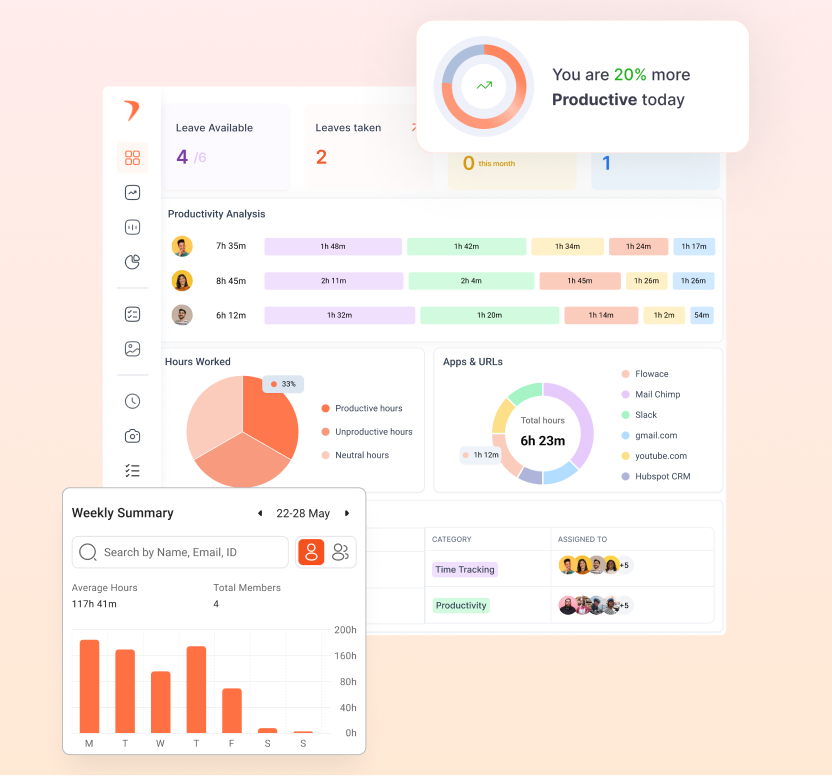
Flowace is built to give you the visibility and insights you need, without resorting to invasive surveillance. Here’s how Flowace fits into a flexible workplace strategy:
- Automatic time tracking: Flowace quietly logs how you spend time across tasks and projects, so managers see output rather than just hours logged.
- Task and project analytics: Teams get detailed reports on progress, helping everyone understand who is working on what and where deadlines may need attention.
- Focus and distraction metrics: Flowace shows which tasks you focus on and which apps or sites take time away, helping improve personal and team productivity.
- Team dashboards: Managers can view overall team activity and workload distribution at a glance, making coordination simpler even with diverse schedules.
In short, Flowace provides the infrastructure to implement flexible schedules effectively. By automatically tracking hours and tasks in the background, it solves the visibility problem without sacrificing employee trust.
Flexible Work Schedules Implementation Checklist
Before you roll out flexible schedules company-wide, use this checklist to make sure you’re ready:
- Eligible Roles/Teams Identified: Which positions genuinely can work flexibly? Start with those (e.g. knowledge workers, creative teams).
- Clear Written Policies: Document everything – who can do what, what “working from home” means, any approved schedules (core hours, maximum remote days, etc.), and the process for approvals.
- Defined Success Metrics: Decide how you’ll measure success (project completion rates, quality scores, response times, etc.), and record baseline data now for comparison.
- Leadership Buy-In: Ensure executives understand the plan and won’t undermine it by insisting on “face time.” Public support from the top is critical.
- Manager Training Completed: All managers should know how to lead flexible teams.
- Transparency Infrastructure: Set up tools like Flowace and clear communication so everyone knows what is tracked and why.
- Pilot Team Chosen: Launch with a small pilot group or department (run 2–3 months). Gather data and feedback before broader rollout.
- Measurement Baseline: Collect current productivity, engagement, and turnover numbers now, so you can measure the impact of flexibility later.
- Tracking System in Place: Deploy time-tracking and project tools to maintain visibility on work.
- Communication Plan: Communicate the policy and its rationale to all employees. Explain what’s changing, what remains expected, and how performance will be monitored.
- Feedback Loops Scheduled: Plan check-ins 1, 3, and 6 months in to survey employees/managers and refining policies as needed.
- Scaling Plan Ready: If the pilot succeeds, have a staged rollout plan for the rest of the organization.
Conclusion
Looking ahead, flexibility will only grow. When paired with clear rules and the right tools, it boosts performance and satisfaction. Flowace helps you monitor work across any schedule, identify bottlenecks, and measure results rather than time spent.
See how flexibility can truly work for your team. Start your free 7-day Flowace trial with full access (no credit card required) or book a demo to explore smarter ways to manage your flexible workforce.
FAQs:
- How do flexible work schedules impact overtime and labor law compliance?
Flexible schedules must still comply with local labor laws on overtime, breaks, and record-keeping, so employers need clear tracking and policies to avoid accidental violations. - Should flexible work schedules be the same for every department?
Not necessarily—different teams may need different models based on customer hours, operational needs, and collaboration patterns, as long as the overall framework is fair and transparent. - How often should we review or update our flexible work policy?
At minimum, review it annually, and more frequently during the first 6–12 months of rollout to incorporate employee feedback, performance data, and any legal or business changes. - Can flexible work schedules work in customer-facing or support roles?
Yes, many support, sales, and service teams use staggered shifts, rotating schedules, or hybrid models to offer flexibility while still maintaining coverage.