Use Monitoring Data for Fair Performance Reviews



Key Takeaways:
- Employee monitoring data is a signal, not a verdict: Logs and metrics provide scale and consistency, but they never explain intent, complexity, or impact on their own. Human judgment must sit between data and decisions.
- Outcomes come before metrics: If a metric does not clearly map to a business outcome like revenue, client satisfaction, or delivery quality, it does not belong in a performance review.
- Aggregated data is more useful than granular surveillance: Weekly or monthly summaries reduce noise, prevent misinterpretation, and avoid the morale damage caused by second-by-second activity tracking.
- No HR action should be taken without manager interpretation: Require documented context, employee input, and corroborating evidence before promotions, warnings, or compensation changes.
- Calibration is what makes data fair: Regular cross-team calibration sessions prevent inconsistent standards, role bias, and unfair comparisons driven by raw numbers.
- Privacy-first configuration protects trust and compliance: Limit data capture, restrict access, define retention windows, and give employees clear appeal paths. Trust is a performance multiplier.
- Monitoring should trigger coaching, not punishment: Use flagged metrics to create structured 30-60-90 plans focused on development, support, and measurable improvement.
- Transparency reduces fear and gaming: Clearly communicate what is tracked, why it matters, who sees it, and how it is used. Ambiguity creates anxiety and attrition.
- Measure the monitoring program itself: Track morale, attrition, and ROI after rollout. If outcomes or trust decline, adjust the system, not just the people.
- The tool you choose shapes behavior: Platforms that emphasize aggregated insights and manager context enable fair reviews. Tools that over-index on raw activity create noise, fear, and poor decisions.
What if the numbers you rely on are only half the story?
You track employee monitoring data to inform promotions, compensation, and staffing. Metrics like utilization, billable hours, and ticket throughput help you see capacity, workload distribution, and delivery patterns across teams. When used well, they give you a structured view of performance at scale.
But raw logs are not the same as the actual value. Treated as a blunt instrument, employee monitoring can lead you to reward low-impact work, miss high performers whose impact is harder to measure, and erode trust with the people you most need to keep.
This article shows you how to turn employee monitoring data into fair, defensible performance reviews that preserve morale. You will get practical steps for adding context, ensuring human judgment, and measuring ROI so your reviews drive real improvement rather than anxiety.
When Employee Monitoring Data Helps And When It Hurts

Monitoring can hurt morale and trust if mishandled. Employees constantly watched can feel distrusted. Surveys find that high levels of monitoring correlate with more stress, lower job satisfaction, and eroded trust.
Why does this keep happening?
- You pick metrics because they are easy to pull, not because they map to business outcomes. That makes the data convenient but often meaningless.
- The numbers arrive without context. Task complexity, client load, approvals, and scope changes rarely travel with the log.
- Managers too often treat the log as final proof. They skip a sanity check with the employee or supporting evidence.
- Employee Monitoring tools surface noisy signals like idle time or raw screenshots that look bad out of context.
- Policies and use cases are vague, so staff and partners do not know what the data will actually be used for.
- You may not have retention or access rules, which creates privacy and compliance exposure.
- When leadership frames employee monitoring as policing, people respond by hiding, gaming, or leaving.
- Finally, you rarely measure the rollout itself. If you do not track morale and ROI after deployment, you will not know if the program helped or harmed the business.
Employee monitoring tools can help reduce this bias by providing objective signals. For example, HR analytics studies show that data-driven evaluation models “enhance fairness by eliminating subjective biases” in traditional reviews. Time-tracking data can highlight effort patterns that managers might otherwise miss, making reviews more fact-based. This unbiased employee monitoring data lets you make fairer, evidence-backed decisions while still protecting morale.
A Step-By-Step Process To Convert Monitoring Signals Into Fair Reviews
You need performance reviews that reflect real value while protecting employee morale. Employee monitoring data can help with both goals when used correctly.
Follow this process and you will:
- Turn noisy logs into defensible review evidence.
- Keep managers honest with human interpretation.
- Protect privacy while preserving useful insights.
- Convert problem signals into coaching plans tied to measurable outcomes.
- Track whether the program actually improves ROI and morale.
Step 1: Define outcomes first
Start by getting clear on what actually matters for each role. For every position, identify three outcomes that represent real business value. For example, a Senior Associate might be evaluated on billable realization, client satisfaction, and matter throughput. A support engineer might be assessed on ticket quality, first contact resolution, and customer NPS.
Once those outcomes are clear, work backward to the metrics. If a metric does not clearly support one of these outcomes, it does not belong in a performance review. This discipline keeps your evaluation framework focused and prevents noisy activity data from being mistaken for meaningful performance insight.
Step 2: Inventory data sources and validate quality
Next, take stock of where your data actually comes from. List every source you might rely on, such as time tracking tools, ticketing systems, code repositories, CRM activity, client feedback, and meeting logs. For each source, document what it captures well and where it falls short.
Before you use any of this information in reviews, run basic quality checks. Normalize time zones so hours are comparable, remove duplicates, and spot-check samples to confirm the data reflects reality. Bad input leads to bad decisions, and nothing undermines trust faster than obvious errors.
Step 3: Choose role-appropriate metrics and use aggregates
With outcomes defined and data sources validated, select the metrics that best reflect those outcomes. Limit yourself to one or two metrics per outcome. More than that usually adds confusion rather than insight. Wherever possible, rely on aggregated views instead of second-by-second activity logs.
For example, billable realization is better represented by weekly billable hours and realization percentage than by minute-level activity. Deep work is more meaningfully captured through weekly focused time blocks, not active-second counts. Aggregated metrics smooth out daily noise, reduce misinterpretation, and avoid the chilling effect that overly granular employee monitoring can create.
Step 4: Require human interpretation before any action
Set a clear rule that no promotion, compensation change, warning, or staffing decision is made based solely on automated signals. Employee monitoring data should inform judgment, not replace it. To enforce this, require managers to complete a short interpretation form before any HR action moves forward.
That form should capture the flagged metric and its raw values, the manager’s interpretation in two or three sentences, the employee’s context and response discussed during the review, and any corroborating evidence such as client feedback, approvals, or ticket notes. It should also include a proposed 30-60-90 coaching plan where improvement or support is needed.
This step forces thoughtful review, catches false positives early, and ensures that every decision is fair, explainable, and defensible.
Step 5: Normalize and calibrate across teams
To keep reviews fair across the organization, you need shared standards. Hold regular calibration sessions with managers and partners, ideally once a month. Use anonymized examples to discuss how metrics should be interpreted for different roles, seniority levels, and client or project cycles.
These conversations help align expectations and surface edge cases early. They also give you a chance to adjust thresholds where the data does not reflect reality for a specific role or workload.
Step 6: Communicate rules and secure buy-in
Before you roll anything out, make the rules explicit. Publish a clear, one-page FAQ that explains what you track, why those metrics exist, who can see the data, and how long it is retained. Include a simple explanation of appeal routes, so employees know how concerns will be handled.
Review this information with team leads and partners ahead of launch so they can answer questions consistently. Where appropriate, collect documented acknowledgement from employees. Transparency at this stage reduces fear, limits speculation, and lowers both trust and legal risk of employee monitoring over time.
Step 7: Configure for privacy by default
Set your employee monitoring tools to collect only what you actually need. Default to aggregated or categorical reporting instead of granular activity logs. Turn off unnecessary captures such as raw screenshots or webcam snaps, and mask personal app names wherever possible. Give employees a manual pause option for personal time so the system reflects real working conditions.
Privacy-first settings reduce risk and protect trust while still preserving the signals you need for capacity planning and performance reviews.
Step 8: Design coaching-first review flows
Treat the signal as an opportunity to clarify expectations and remove blockers. Work with the employee to create a collaborative 30-60-90 plan that uses the data to set clear, measurable milestones tied directly to business outcomes.
A simple structure works best. Define the objective and the metric it relates to, outline what progress looks like at 30, 60, and 90 days, and document the support required from the manager or organization. This approach keeps the focus on development and improvement rather than punishment, and it makes progress easy to track over time.
Step 9: Lock down access, retention, and appeal
Once monitoring data is in use, control how it is accessed and for how long it exists. Limit visibility of raw logs to a small, clearly defined group. Use role-based permissions and maintain an audit trail that records who accessed the data and for what purpose. This prevents casual misuse and reinforces accountability.
Set clear retention windows and automate the deletion of raw data once it is no longer needed. Just as important, establish a simple appeal process that allows employees to explain context or challenge specific data points. Strong access controls, retention rules, and appeal paths reduce compliance risk and reinforce trust.
Step 10: Measure impact and iterate
Do not treat monitoring as a one-time rollout. Treat it like a product that needs ongoing measurement and refinement. Run short pulse surveys at 30 and 90 days to understand how employees perceive fairness, clarity, and trust. In parallel, track ROI metrics tied to your original outcomes, such as utilization shifts, billable realization, client satisfaction, and voluntary attrition.
If morale declines or the expected business impact does not materialize, adjust quickly. Change thresholds, update policies, or revisit how managers are using the data. Continuous measurement and iteration ensure the program delivers real value without unintended harm.
A 30-60-90 Performance Improvement Framework Managers Can Use
Use this as your standard for turning a flagged metric into a focused development plan. Fill every section before the first 1:1.
Keep it visible to the employee and to the manager who will run the check-ins.
Objective
One line that links the metric to a business outcome. Include baseline and target.
Example: Increase billable realization from 60 percent to 75 percent over 90 days to improve matter profitability.
Why this matters
One sentence that ties the objective to ROI or client outcome.
Example: Higher realization improves revenue per partner and reduces write-offs.
Metric and data sources
Name the metric, how it is calculated, and which sources you will use. Include the baseline value and the frequency of measurement.
Example: Weekly billable hours and realization percentage from the time tracker and billing system. Baseline 60 percent. Measured weekly.
Ensure all data collection follows internal compliance standards and employee monitoring data protection policies to safeguard privacy and regulatory alignment.
30-day Milestone
A specific, measurable, short-term step that is achievable in one month. Include the owner and evidence required.
Example: Owner: Associate. Milestone: Increase weekly billable hours by 10 percent and submit two time entries per day with task detail. Evidence: Time export and sample task notes.
60-day Milestone
A clear mid-point that shows momentum and removes blockers. Include the owner and evidence.
Example: Owner: Associate. Milestone: Reach 68 percent realization and complete one client reforecast to align scope. Evidence: Billing report and client email.
90-day Milestone
The target and the success criteria. State exact numbers and the minimum acceptable outcome. Include the owner and evidence.
Example: Owner: Associate. Milestone: Reach 75 percent realization. Success: 75 percent or higher sustained for two consecutive weeks. Evidence: Billing report and manager sign-off.
Support Required
List the concrete support the manager or the firm will provide. Be explicit about resources, time, and changes in process.
Example: Two weekly 30-minute coaching sessions. Reassignment of one low-value admin task. Access to a billing mentor for one month.
Measurement Cadence and Check-ins
How often will you review progress, and who attends? Keep cadence short early on.
Example: Weekly check-ins for the first month, then biweekly. Participants: Associate and manager. Monthly calibration with the partner as needed.
Success Criteria and Exit Conditions
Define what counts as success and what happens if success is not reached. Include next steps and timelines for escalation.
Example: Success: Sustained 75 percent realization for two weeks. If not met, extend coaching for 30 days or move to a formal performance plan after documented attempts.
Risks and Blockers
Note potential external factors that could affect outcomes and how you will handle them.
Example: Risk: Client scope changes reduce billable capacity. Mitigation: Reforecast and adjust milestones with manager approval.
Communication and Documentation
Where the plan is stored and who has access. Confirm the employee gets a copy.
Example: Store in HRIS under coaching plans. Employee and manager have access. Manager logs progress notes weekly.
Owner and Review Date
Name the person responsible for driving the plan and the date of the next formal review.
Example: Owner: Jane Manager. Next review: 30 days from plan start.
How Managers Should Use This Template
Managers should use it as a shared working document that turns performance signals into clear, achievable next steps. The goal is alignment and progress:
- Fill it jointly with the employee in the first meeting.
- Make milestones small and visible.
- Record evidence at each check-in.
- Treat the document as a living plan. Update milestones if valid blockers appear.
- Use calibration meetings to align expectations across teams.
Final Thoughts
Employee monitoring data is not the problem. How you interpret and apply it is. Used thoughtfully, monitoring data gives you scale, consistency, and evidence. It helps you see patterns that no single manager could catch on their own. It reduces blind spots and, when paired with calibration, can actually make reviews fairer than purely subjective judgment ever was.
But raw logs are never the full story. When you treat activity as value, or automation as authority, you trade insight for anxiety. You reward visibility over impact, discourage trust, and push strong performers to disengage or leave.
That’s why choosing the right employee monitoring tool matters the most. If you want monitoring to inform fair, development-focused reviews, choose a platform that surfaces aggregated, outcome-aligned signals and forces human interpretation.
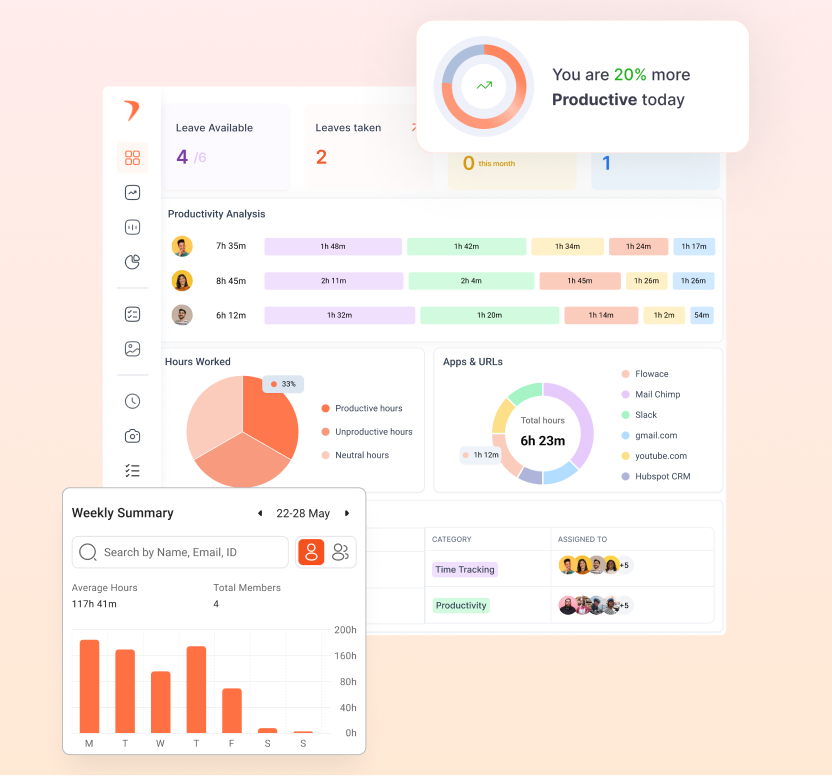
Flowace is built around that idea. It emphasizes automated time capture, AI activity categorization, and aggregated reports designed to map activity to outcomes rather than to dramatize every second of work. Use it to pull role-appropriate summaries, attach manager notes, and export defendable evidence for review conversations.
On pricing and trials, Flowace publicly offers tiered plans and a free trial so you can pilot how its aggregated views and manager annotations work for your teams before committing. Depending on the tier, organizations typically see per-user pricing in the low single digits up to roughly the high single digits per user per month.
Check out our official pricing page and recent listings for a clear pricing breakdown that fits your needs.
FAQs:
Can I use employee monitoring data in performance reviews?
Yes, but only with transparency, a lawful basis, and human review. Tell people what you collect and why, complete any required DPIA, and never base a decision solely on automated signals. (ICO guidance).
What employee monitoring data should never be used for reviews?
Avoid sensitive health or biometric signals unless they are strictly job-related and legally justified. These data types carry high legal and discrimination risk. (ICO enforcement examples; EEOC guidance on wearables).
How do I prevent monitoring from killing morale?
Be transparent, limit what you collect, default to aggregated views, require manager interpretation, and use flags for coaching rather than punishment. Run pulse surveys after rollout and act on feedback. (ACAS; research on monitoring and stress).
Does monitoring reduce bias in reviews?
It can help reduce certain subjective biases if metrics are outcome-aligned and used alongside human judgment and calibration. Data is a tool to surface patterns, not an impartial arbiter. (HR analytics research).
Should employees consent to monitoring?
Where law requires it, yes. Even when consent is not strictly required, consulting employees and getting documented acknowledgement improves legitimacy and reduces pushback. (ACAS, ICO).