Healthcare Virtual Assistant: Benefits & Best Practices




Key Takeaways:
-
Administrative overload is burning out clinicians – Physicians spend up to 50% of their day on non-clinical tasks, costing practices hundreds of thousands annually in lost productivity.
-
Healthcare virtual assistants (VAs) can take over repetitive admin tasks – Tasks like scheduling, billing, insurance verification, transcription, and patient communication can be offloaded to virtual staff, freeing clinicians to focus on care.
-
Human vs. AI assistants serve different roles – Human VAs excel at complex, judgment-heavy tasks, while AI tools handle routine, repetitive work at scale. The most effective model is hybrid.
-
VAs reduce costs and increase responsiveness – They provide 24/7 support, improve patient satisfaction, streamline workflows, and reduce payroll and overhead costs by up to 60%.
-
HIPAA compliance and proper setup are essential – Practices must implement secure access, BAAs, audit trails, and clear protocols to ensure data privacy and legal compliance.
-
Flowace solves the biggest challenge with virtual assistants: visibility – It tracks task completion, time allocation, SLA compliance, and productivity in real time, helping practices prove ROI and optimize workflows.
-
Flowace offers privacy-respecting performance monitoring – With AI-driven productivity scoring, real-time dashboards, and task-level insights, Flowace helps manage VAs without micromanaging.
-
The future of healthcare admin is hybrid – Successful practices will combine human empathy and problem-solving with AI-powered automation to meet rising demands efficiently and ethically.
If your medical team spends hours every week on tasks that have nothing to do with patient care, you are adding unnecessary pressure to an already overworked staff.
Scheduling appointments, verifying insurance, transcribing notes, processing billing and coordinating referrals are all responsibilities a virtual medical assistant can handle more efficiently.
But most healthcare practices struggle with virtual assistants because managing them effectively is nearly an impossible task.

The good news? This challenge has a solution.
When managed effectively, healthcare virtual assistants can reduce administrative costs and dramatically improve patient satisfaction.
What is a Healthcare Virtual Assistant?
A healthcare virtual assistant is a remote professional who takes over non-clinical tasks. Although they work remotely, they integrate smoothly into your daily operations. This includes updating your EHR, communicating with patients, coordinating care and keeping administrative work on track so your clinical team can focus on patient care.
What sets a healthcare VA apart from a general virtual assistant is their specialization. They understand HIPAA rules, follow strict patient privacy guidelines and know how to use EHR systems.
They also understand the day-to-day flow of a medical practice, from managing no-shows to resolving insurance issues, making them a more reliable fit for healthcare settings.
Human Virtual Assistants vs. AI-Powered Healthcare Assistants
Right now, AI growth is accelerating rapidly across industries, and healthcare is no exception. This naturally raises an important question: do you need human virtual assistants, AI tools, or a combination of both to get more done?
Let’s compare:
Human Healthcare Virtual Assistants
Human VAs are real people hired directly or through outsourcing companies to manage administrative workflows. They handle tasks like scheduling, transcription, data entry, patient communication and complex problem-solving. Their biggest strengths are judgment, adaptability and the ability to manage exceptions.

For example, when a patient has a complicated insurance issue or a scheduling conflict that requires creative thinking, a human VA can listen, engage and find the right solution.
AI-Powered Healthcare Assistants
AI assistants such as chatbots, automated scheduling tools and IVR systems are built to manage high-volume, repetitive tasks. They excel at sending 24/7 reminders, collecting patient intake data, answering basic FAQs and automating follow-ups. They operate continuously, never need breaks and can scale instantly without the cost of additional staff.
| Category | Human Healthcare Virtual Assistant | AI-Powered Healthcare Assistant |
| Best For | Complex, sensitive, or judgment-heavy work. | Routine, predictable, and repetitive workflows. |
| Strengths | Empathy, nuance, flexibility, problem-solving and handling exceptions. | 24/7 availability, instant scalability, consistent performance, low marginal cost. |
| Weaknesses | Limited by human capacity, fatigue and higher ongoing costs. | Lacks human judgment, struggles with complex scenarios, requires careful setup. |
| Cost Structure | Hourly or monthly fees; increases with workload. | Subscription or usage-based fees; scales without additional hires. |
| Scalability | Linear — more tasks require more staff. | Exponential — can manage unlimited volume. |
| Availability | Typically business hours unless scheduled for shifts. | Always on — 24/7 response capability. |
| Accuracy & Consistency | High for complex tasks; may vary with fatigue or turnover. | Extremely consistent for structured tasks. |
| Handling Edge Cases | Excellent — can improvise, reason and escalate. | Limited — needs human backup for exceptions. |
| Compliance & Privacy (HIPAA) | Can be trained and monitored for compliance. | Depends on vendor safeguards; must be configured properly. |
| Training & Onboarding | Requires training time and ongoing supervision. | Fast to deploy; needs setup and workflow design. |
| EHR Integration | Works directly inside EHR systems with training. | Integrates via APIs or automation for structured tasks. |
| Patient Experience | Personalized, empathetic, human interaction. | Fast, reliable, but not emotional or empathetic. |
| Typical Tasks | Insurance calls, prior authorizations, complex scheduling, sensitive communication, data coordination. | Reminders, intake forms, FAQs, follow-ups, automated scheduling. |
| Ideal Use Cases | Tasks requiring judgment, conversation, or problem-solving. | High-volume, low-complexity administrative workflows. |
| ROI Timeline | Weeks to months depending on training. | Days to weeks with proper setup. |
| Quality Control | Requires reviews, feedback, and consistent management. | Analytics-driven monitoring and periodic tuning. |
When we look at the current working landscape, every sector is a blend of human judgment and AI-driven efficiency to keep up with the rising demands.
In 2026, the most successful healthcare practices should rely on a hybrid model. AI will continue to excel at high-volume, repetitive tasks while human VAs can handle complex insurance cases, sensitive patient conversations, nuanced scheduling issues and clinical coordination, which requires judgment, empathy and situational awareness.
The Growing Role of Virtual Support in Modern Healthcare
The healthcare VA market is projected to reach $19.5 billion by 2035. That explosive growth isn’t accidental. It’s driven by three converging forces:
- Physician burnout is soaring: Over 50% of doctors feel burned out, mainly due to administrative overload. While rates have improved since the pandemic, the crisis is far from over.
- Telehealth adds new admin demands: Virtual visits require scheduling, intake forms, managing online waiting rooms and coordinating follow-ups. A mix of human VAs and automated tools handles these tasks smoothly.
- Labor costs keep rising: Hiring full-time admin staff can cost $47,000–$53,000+ a year. Healthcare VAs, whether domestic or international, deliver similar capabilities at 40–60% lower cost.
Why Healthcare Practices Need Virtual Assistants?
Let’s quantify the real cost of administrative overload. Studies show that physicians spend just 4 hours a day on non-clinical tasks. In a practice with five full-time clinicians working 50 weeks per year, that amounts to 5,000 hours annually lost to administrative work.
At an average physician opportunity cost of $75–$150 per hour (time that could otherwise be spent on revenue-generating patient care), that translates to $375,000 to $750,000 per year drained by administrative overhead.
Your clinical staff didn’t go to medical school to do this work. And every hour they spend buried in forms and follow-ups, it’s costing your revenue.
Even if physicians are freed from administrative duties, delays in completing those tasks can quickly lead to financial fallout.
Top 10 Benefits of Healthcare Virtual Assistants

The demand for Healthcare Virtual Assistants (HVAs) are on the rise for the following reasons:
1. Reduced Administrative Costs and Overhead
Every practice knows the sting of rising payroll, rent, and overhead. You hire great people… but still feel like you’re bleeding money every month. A healthcare VA changes that story. Hiring a healthcare VA keeps your operations running smoother than ever.
2. 24/7 Patient Support and Engagement
Patients don’t stop needing care at 5 p.m. With a VA, someone will always be there to take care of scheduling patient appointments, automate appointment reminders, and respond to basic questions 24/7.
3. Better Scheduling and Coordination
Scheduling issues can disrupt your entire day. Missed calls, constant rescheduling, and unfilled appointment slots create unnecessary chaos. A healthcare VA helps manage your schedule efficiently by handling bookings, follow-ups, and changes. This keeps your calendar full, reduces gaps, and ensures patients get timely appointments.
4. Happier Patients Who Stay Longer
Patients value quick responses, clear communication, and easy access to support. A VA helps with reminders, billing questions, and appointment guidance, which creates a smooth patient experience. This leads to higher satisfaction, stronger loyalty, and better retention.
5. Faster Documentation and Transcription
Clinicians often spend hours completing notes after a full day of patient care. A VA helps with transcription and documentation, entering information into the EHR accurately and on time. This reduces administrative strain, helps clinicians end their day earlier, and keeps records updated for better care continuity.
6. Stronger Billing and Faster Payments
Billing errors and delays can slow down your revenue. A VA helps ensure accurate coding, timely claim submissions, and regular follow-ups with payers. This reduces denials, improves cash flow, and ensures your practice gets paid for the services delivered.
7. Cleaner Data, Fewer Mistakes
Accurate records are essential for patient care, billing, and compliance. A VA maintains up-to-date patient information, organizes documentation, and reduces errors. This creates smoother workflows and lowers the risk of compliance issues.
8. More Time for Real Patient Care
When clinicians are not overloaded with administrative tasks, they can spend more time focusing on patients. This leads to better-quality care, improved patient interactions, and higher clinician satisfaction.
9. Easy Scaling Without Hiring Stress
As your practice grows, your administrative needs grow too. A VA allows you to scale support quickly without the long hiring process associated with full-time staff. You can increase or reduce support based on workload without complicated HR steps.
10. Reliable HIPAA-Compliant Support
Healthcare VAs are trained in HIPAA regulations and follow proper privacy and security protocols. They help maintain patient confidentiality and reduce the risk of compliance violations, giving your practice added peace of mind.
Key Tasks Healthcare Virtual Assistants Handle
Healthcare virtual assistants play a critical role in keeping a medical practice running efficiently. They manage:
1. Patient-Facing Responsibilities
Healthcare VAs often serve as the first point of contact for patients, which requires professionalism, accuracy, and an understanding of clinical workflows.
- Appointment Scheduling and Coordination: They manage appointment calendars, book new visits, coordinate between providers, handle cancellations or rescheduling, send reminders across multiple channels, and follow up on no-shows.
- Patient Intake and Data Collection: VAs gather intake forms, verify insurance details, document medical histories, review medication lists, and ensure all consent and authorization documents are completed.
- Patient Communication: They respond to routine questions, clarify billing statements, coordinate the delivery of lab results, and send reminders for refills, screenings, or follow-up appointments. For practices supporting patients with ongoing metabolic health needs, approved resources such as Trulicity metabolic health info can also help keep follow-up conversations clearer and more patient-friendly.
- Insurance Verification and Prior Authorization: VAs contact insurance companies to confirm coverage, collect benefit information, obtain prior authorizations for procedures, and update both patients and clinicians on the status.
- First-Call Triage and Routing: They answer incoming calls, separate routine inquiries from urgent ones, route urgent matters to the right clinicians, and provide answers using approved scripts or knowledge bases.
2. Administrative and Backend Support
Behind the scenes, VAs keep essential processes moving so the practice stays compliant, efficient, and well-organized.
- Medical Transcription: They transcribe clinician dictation, enter clinical notes into the EHR, and request clarification when documentation is incomplete.
- Billing and Coding Assistance: VAs prepare claims, check coding accuracy, submit insurance forms, follow up on denials, and match payments with patient accounts to maintain clean financial workflows.
- EHR Data Entry: They update patient records with test results, medication changes, and clinical findings to ensure real-time accuracy.
- Referral Coordination: They initiate referrals, track their progress, communicate with specialists, and support continuity of care across providers.
- Report and Documentation Support: VAs generate patient reports, compile administrative documents, and assist with correspondence needed for clinical or operational purposes.
3. Practice Management Support
Beyond patient and administrative tasks, VAs help maintain operational fluidity across the entire practice.
- Inventory and Supply Management: They track supply levels, reorder inventory, manage expiration dates, and coordinate deliveries to prevent shortages.
- Schedule Optimization and Provider Coverage: VAs manage provider schedules, handle time-off requests, coordinate coverage, and optimize scheduling to ensure maximum utilization.
- Correspondence Management: They monitor communication channels, handle patient messages, and ensure timely responses across email, phone, and portal systems.
- Staff Coordination Support: They assist with internal communication, help manage staff schedules, and support HR-related administrative work.
How to Seamlessly Integrate a Healthcare Virtual Assistant Into Your Practice?
This step-by-step guide walks you through a practical, proven approach to adopting healthcare virtual assistants:
Step 1: Audit & Prioritize
Start by auditing your practice’s current workload. Ask your team to track their activities for 2-3 weeks. You’ll likely find that 30-40% of their time is consumed by 5-7 specific, repetitive tasks.
Those high-volume, repetitive tasks are your priority targets for delegation. They’re the easiest to document, the easiest to train a VA on, and the ones that free up the most clinical time.
Step 2: Choose Your Model: Human, AI, or Hybrid
Ask yourself these questions:
- Do I need 24/7 coverage or business-hours support? AI-powered systems provide 24/7 availability; human VAs typically work set hours.
- How complex are the tasks? Simple, rules-based work (appointment reminders, form completion) suits AI. Complex, judgment-based work (insurance negotiation, clinical coordination) requires humans.
- What’s my budget? AI systems have higher upfront costs but lower per-interaction costs. Human VAs have ongoing salary/hourly costs.
- Do I need to scale rapidly? Human VAs scale slowly (hiring takes time). AI scales instantly.
Answering these questions will help you understand exactly what your practice needs. In most cases, the best place to begin is with a hybrid model.
Use AI to manage high-volume, low-complexity tasks, and bring in a human VA to handle the nuanced, judgment-based work. This balance gives you efficiency without losing the human touch where it matters most.
Step 3: Ensure HIPAA Compliance and Data Security
Before onboarding any virtual assistant (human or AI), establish these controls:
- Signed Business Associate Agreements (BAA): Required by law for anyone accessing patient data
- Secure access infrastructure: VPN, encrypted logins, role-based access to specific EHR data only
- HIPAA training: Mandatory for all VAs before they handle patient information
- Audit trails: Track who accesses what data and when
- Data residency: Confirm where patient data is stored (on secure servers, not personal devices)
- Incident response plan: Document what happens if a security breach occurs
Step 4: Establish Clear Workflows and Communication Protocols
Vague instructions lead to rework and frustration. Instead, document clear workflows:
- Appointment scheduling protocol: What fields must be filled? What information triggers a clinical staff review? How quickly must the VA respond?
- Insurance verification process: What questions must the VA ask? What information must be documented? When should the VA escalate to a manager?
- Billing follow-up workflow: What triggers a claim inquiry? How many follow-up attempts before escalation?
- Transcription standards: What EHR system is used? What fields are required? What quality standard must be met?
Step 5: Monitor Performance and Measure ROI
Most practices fail to measure whether the VA is delivering value. You need to track:
- Task completion rates – Are appointments being scheduled within SLA (e.g., 24 hours of patient request)?
- Time allocation – How much time is the VA spending on high-value work vs. low-value busywork?
- Quality metrics – Are patient records being entered accurately? Are claims being submitted correctly?
- Patient impact – Are appointment no-show rates dropping? Is patient satisfaction improving?
- Financial impact – What’s the direct ROI in terms of recovered appointments, improved billing, or clinician time saved?
When you understand where your VA excels (or struggles), you can refine workflows, provide better guidance, or delegate more tasks confidently.
How Flowace Supports Healthcare Virtual Assistant Management
When you hire a virtual assistant, one critical problem you face is not being able to see what they actually do and whether their work is creating real value. Without that visibility you get no proof of impact.
- You don’t know whether tasks are completed on time or to standard.
- You can’t tell if the VA is spending time on high-value work or low-value busywork.
- Quality issues (wrong codes, incomplete notes) go unnoticed until they become expensive problems.
- Patient experience and revenue signals (no-show rates, claim denials, A/R days) remain disconnected from the VA’s performance.
- Stakeholders can’t see ROI, so buy-in evaporates and the practice reverts to old habits.
What you should track (minimum):
- Task completion rates and SLA compliance.
- Time allocation by task.
- Quality sampling (EHR entry accuracy, claim correctness).
- Patient impact (no-show, satisfaction).
- Financial outcomes (recovered appointments, faster payments, clinician hours reclaimed).
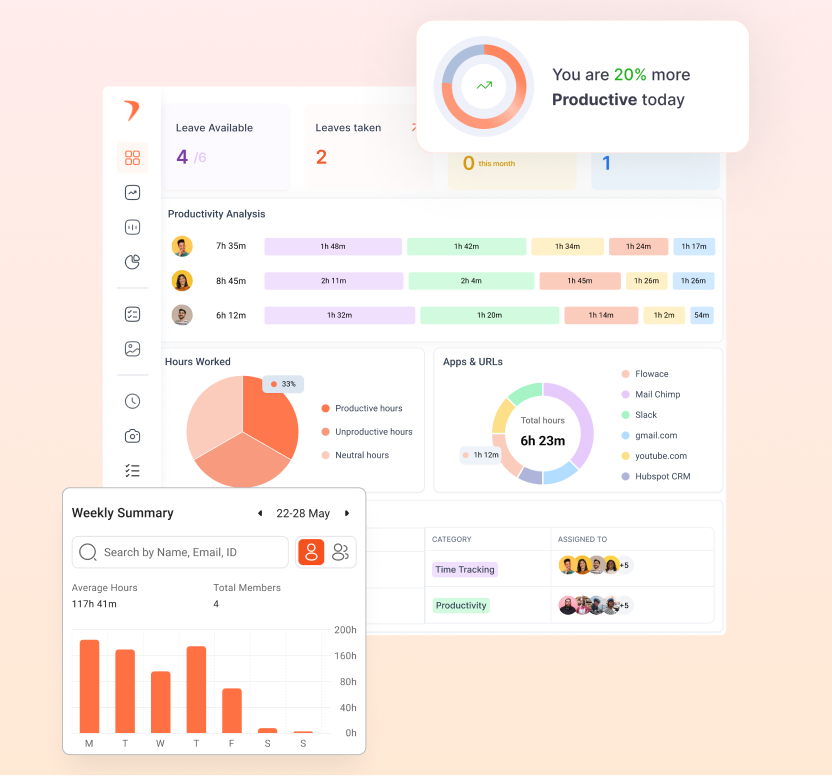
Flowace handles this by giving you real-time visibility into your VAs work. Flowace provides real-time dashboards that show exactly who did what, when, and for how long. Its time-by-task reporting helps you confirm that hours are spent on high-value work, while SLA alerts flag missed deadlines before they cause bigger problems.
It offers:
Time Tracking for Remote Healthcare Administrative Staff
Flowace automatically tracks exactly how your VA spends their day, breaking down time per task, daily activity logs, and task-based reports so you can measure workload distribution and optimize efficiency.
Productivity Monitoring Without Invading Privacy
Flowace uses AI-powered productivity scoring to track active vs. idle time, app usage, work patterns, and potential burnout—all while respecting privacy and ensuring compliance.
Task Management and Project Tracking
Flowace organizes VA work by project or task, automatically tracking time spent on scheduling, billing, insurance verification, and transcription to generate SLA reports and performance insights.
Performance Dashboards for Virtual Healthcare Teams
Flowace provides real-time dashboards showing task completion rates, time allocation, SLA compliance, productivity trends, and workload distribution, helping practices optimize, scale, and prove ROI.
Conclusion
Healthcare practices is at its inflection point. The old model—where physicians and clinical staff handle administrative work in addition to patient care—no longer works. Burnout is unsustainable, costs are rising, and patients expect 24/7 responsiveness.
The practices that win right now are those that delegate administrative work to qualified virtual assistants. But you need visibility into whether that investment is actually delivering value.
Flowace bridges that gap, giving you real-time insights into task completion, time allocation, and productivity without compromising privacy.
Start your free trial or book a demo with our team today to see how Flowace helps practices like yours manage virtual support confidently and scale without guesswork.
FAQs:
- What qualifications should I look for in a healthcare virtual assistant?
Look for experience in medical admin tasks, HIPAA training, knowledge of EHR systems, and strong communication skills. Medical billing or coding certifications are a plus if needed. - How do I train a virtual assistant for a specialized workflow in my clinic?
Use screen recordings, step-by-step SOPs (standard operating procedures), and short live walkthroughs. Start with 2–3 core tasks before gradually expanding responsibilities. - Can virtual assistants make outbound calls to patients?
Yes, if permitted under local laws and with proper scripting, they can confirm appointments, follow up on no-shows, and assist with billing or referrals via secure phone systems. - What’s the average onboarding time for a healthcare practice using Flowace?
Most clinics can get started within 1–3 days with minimal setup, thanks to intuitive workflows and guided onboarding support. - Can Flowace measure how much time VAs spend on low-value vs. high-value work?
Yes, Flowace categorizes time by task type, so you can instantly identify where effort is wasted and where to optimize delegation. - Do I need a large team to benefit from Flowace?
No, Flowace is ideal for both small practices and large organizations. Even solo clinicians with one VA can use it to increase visibility and efficiency.