BPO Employee Monitoring Software Evaluation Checklist



BPO operations leaders sit in an awkward squeeze: clients want SLA proof, regulators want audit trails, and QA leads want real visibility into how work gets done. Most BPO employee monitoring software was designed with none of those people in mind. It was built for the generic office manager trying to catch someone “slacking.”
What follows is an evaluation framework for SLA managers, QA leads, and compliance officers who need a vendor decision they can defend. It starts with the basics, moves into the edge cases that derail rollouts, lays out a 28-point checklist across six categories, and finishes with a scoring model you can bring straight into your next demo.
For BPO leaders in India and globally, six non-negotiables define effective monitoring:
Flowace is positioned around operational visibility and better decision-making rather than surveillance. This approach has led to measurable success, such as helping a global insights firm stop leaking ₹169L a month.
What BPO Employee Monitoring Software Actually Needs to Do
BPO monitoring software has to satisfy three constituencies at once: client-facing SLA proof, internal QA improvement loops, and regulatory compliance documentation. Those requirements need to roll up to one shared data layer. When SLA pulls from one system, QA from another, and compliance stitches together audit logs by hand, you do not have a monitoring strategy. You have three disconnected problems that happen to share a label.
A lot of products in this category are general workforce trackers with a BPO badge slapped on in marketing. They typically miss the essentials: multi-client segmentation, shift-aware analytics, and audit-grade logging. The global BPO market is projected to reach $525.23 billion by 2030, according to Grand View Research (Business Process Outsourcing Market Report (2024–2030)). The software stack underneath it has not caught up.
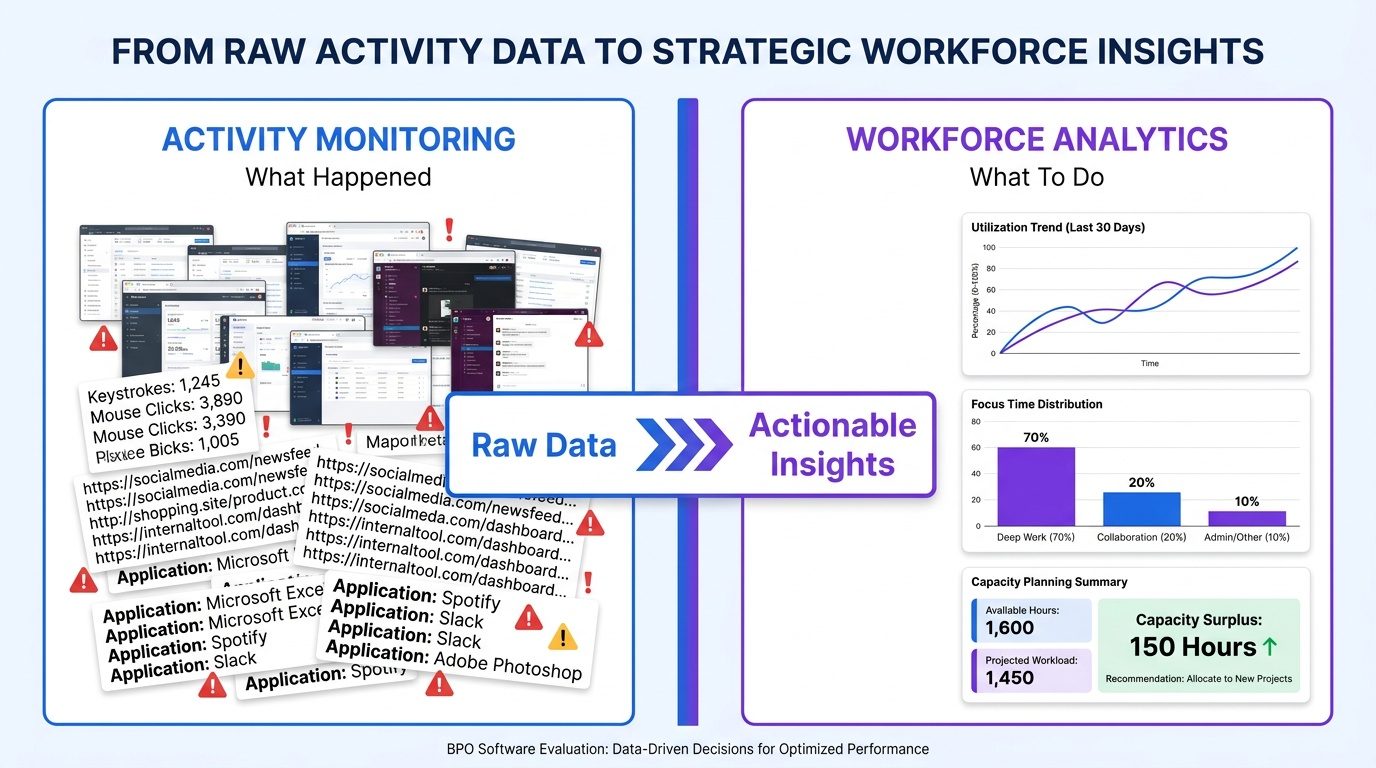
It also helps to separate activity monitoring from workforce analytics. Activity monitoring records what happened: screenshots, keystrokes, URLs, app logs. Workforce analytics answers what it means: utilization patterns, focus signals, capacity gaps, workflow completion rates. BPOs get paid on the second set of outputs. The first produces a lot of data. The second produces decisions. For a broader view of how employee monitoring software fits into workforce operations, that distinction should shape your evaluation from day one.
Discover how Flowace boosts operational visibility
How SLA, QA, and Compliance Teams Evaluate Tools
SLA, QA, and compliance teams often view monitoring software through distinct, sometimes conflicting priorities, necessitating a careful equilibrium. This conceptual “BPO Monitoring Evaluation Triangle” highlights how SLA specialists focus on real-time performance and client deliverables, QA leads seek deep process transparency, and compliance officers demand rigorous, legally defensible data logs. A high-performing solution must bridge these gaps to satisfy all three organizational pillars.
During a vendor showcase, these three departments look for very different indicators of success. Within the Evaluation Triangle, SLA visibility translates to immediate adherence metrics, QA insight focuses on granular activity flow, and compliance defensibility centers on encryption, access management, and regional data residency. If a platform excels in one area while ignoring another, the resulting friction typically surfaces shortly after deployment. This model is designed to make those necessary tradeoffs visible early on.
SLA Teams: Real-Time Adherence and Client Reporting
SLA managers need schedule adherence tracking, idle-versus-productive time broken out by client account, and automated breach alerts. Latency is the make-or-break detail. If utilization data shows up 24 hours later, it is not an SLA tool. It is a postmortem tool. By the time the dashboard updates, the client has already recorded the miss.
Real-time data allows for immediate intervention. For example, an enterprise BPO using Flowace grew active hours by 15.9%, generating ₹3.33Cr in additional value. By shortening the response window, you protect the SLA.
QA Teams: Process Visibility Without Micromanagement
QA needs pattern-level signal: which workflows generate rework, where attention breaks during complex processes, and which application sequences correlate with errors. The common failure mode is leaning too hard on screenshot frequency. Screenshots feel like proof. In practice, they are mostly noise.
Effective QA focuses on workflow optimization. By prioritizing application-usage flow over noise-heavy screenshots, teams can drive productivity and identify structural bottlenecks that raw activity counts miss.
Compliance Teams: Audit Trails, Data Residency, and Access Controls
Compliance scoring is often binary. GDPR data residency, SOC 2 certification, and role-based access controls either exist or they do not, and “almost” does not count. Under Regulation (EU) 2016/679 (GDPR), employee monitoring requires a lawful basis, and the employer’s interest must be balanced against the employee’s right to privacy. If you serve EU clients, that documentation needs to be in place before any rollout.
Compliance requires global rigor. A secure framework ensures that data residency and role-based access controls are enforced per contract terms, maintaining audit readiness across multiple jurisdictions and regulatory bodies.
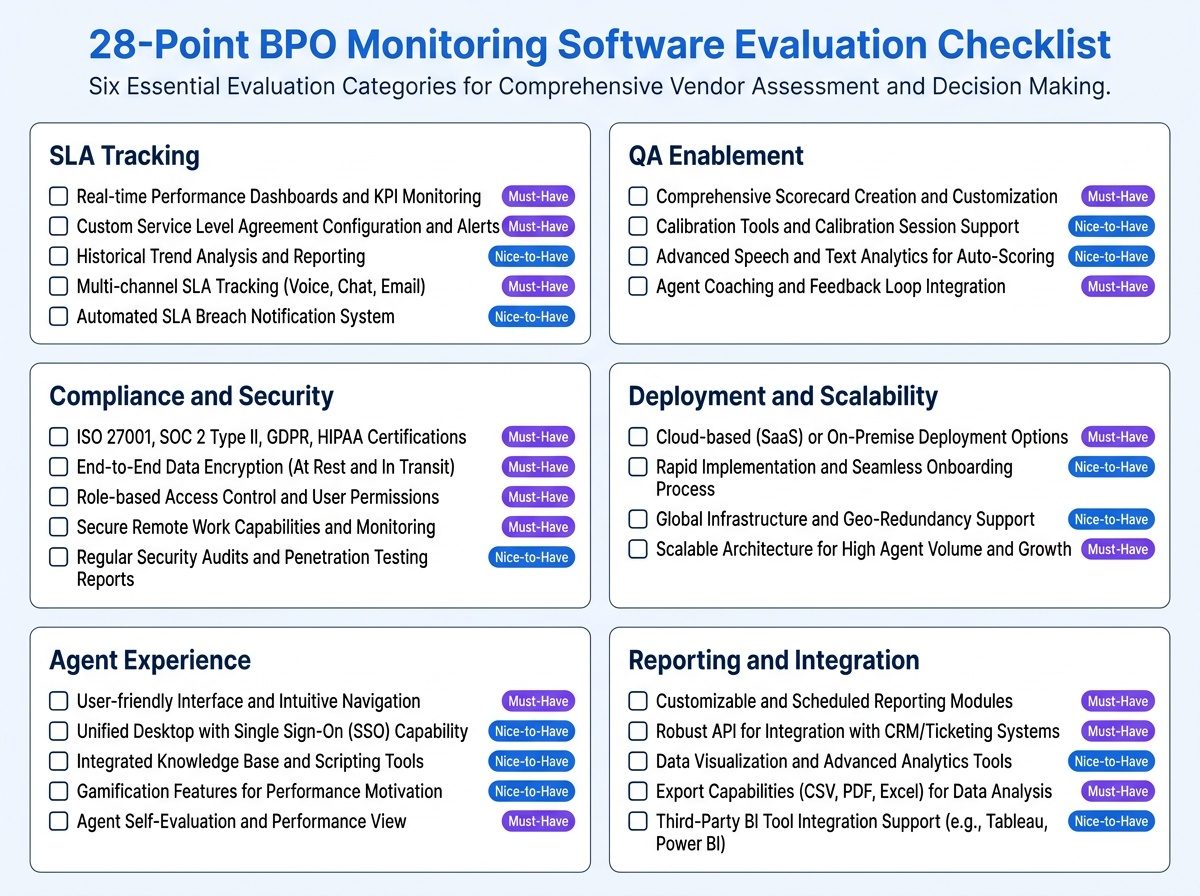
The Evaluation Checklist: 28 Criteria Across 6 Categories
A serious BPO employee monitoring software evaluation should span six categories: SLA tracking, QA enablement, compliance and security, deployment and scalability, agent experience, and reporting and integration. The weighting depends on what you run. A domestic healthcare BPO will weight compliance highest. A customer support BPO will weight SLA tracking highest. A back-office processing BPO will weight QA enablement highest.
SLA Tracking and Adherence Criteria
Must-have criteria for SLA teams:
- Real-time schedule adherence tracking (must-have): for example, a frequent data refresh at minimum
- Multi-client time segmentation (must-have): utilization attributable per client account, not just per agent
- Automated SLA breach notifications (must-have): push alerts to floor managers before the breach compounds
- Client-specific dashboard exports (nice-to-have): formatted reports that match client reporting templates
QA Enablement and Productivity Signal Criteria
What QA teams should score vendors on:
- Application usage tracking with workflow sequence visibility
- Focus time versus fragmented time metrics at the individual and team level
- Task completion signals tied to specific process steps
- Team-level benchmarking to identify outlier performance patterns
A note on “active time” as a QA metric: it is usually the wrong proxy. An agent can post a full day of active time and still spend a significant portion of those hours in the wrong application. Hours without context do not tell you anything about process quality. Using monitoring data for performance reviews demands the same contextual discipline; skip it and QA ends up defending numbers that do not map to real outcomes.
Compliance, Security, and Data Governance Criteria
Compliance checklist (skip this section if you handle no regulated client data):
- SOC 2 certification: required for enterprise client contracts
- GDPR and CCPA compliance documentation: required for EU and California-based client data
- Data residency options: jurisdiction-specific storage for regulated data
- Role-based access controls: limit who can view agent-level monitoring data
- Audit log immutability: logs that cannot be edited or deleted after the fact
- Data retention and purge controls: per-client configuration of retention windows
Deployment, Scalability, and Agent Experience Criteria
BPO attrition runs at 30 to 40 percent annually according to NASSCOM BPM Workforce Trends (2023) data. Tools that slow machines, feel invasive, or demand constant agent interaction tend to push that number higher. Silent versus visible installation is not a minor implementation detail; it is a product decision with workforce consequences. Platform coverage matters as well: Windows, Mac, Linux, and Citrix or VDI environments are all common in large deployments. For an enterprise-scale deployment, onboarding time should be a first-class evaluation topic, not something you ask about after procurement. For the ethics behind these choices, monitoring remote employees ethically is worth reading before you lock your RFP.
How BPO Employee Monitoring Software Stacks Up: Vendor Comparison
The right pick depends on your client mix, regulatory exposure, and operating scale. No single vendor wins across all evaluation categories. The summary below scores six leading vendors against the checklist categories on a 1 to 5 scale, where 5 is strongest. Ratings reflect publicly documented capabilities and verified user feedback as of 2026.
Before comparing vendors, it’s useful to understand which capabilities actually matter. Reviewing workforce analytics and monitoring features can help teams distinguish between operational visibility tools and traditional activity-tracking software.
Vendor comparison summary (SLA Tracking / QA Enablement / Compliance / Deployment / Agent Experience / Reporting):
- Flowace (5 / 5 / 5 / 5 / 5 / 5): Strong across SLA tracking, reporting, compliance readiness, and deployment fit for India-based BPOs.
- Hubstaff (4 / 3 / 3 / 4 / 3 / 4): Strong GPS and time tracking for field-adjacent BPOs. Screenshot-heavy QA approach limits process insight. Compliance coverage adequate for mid-market but not healthcare-grade.
- Time Doctor (4 / 3 / 3 / 3 / 3 / 3): Reliable time tracking with client billing features. Limited workforce analytics depth. Agent experience concerns at scale due to visible monitoring prompts.
- ActivTrak (3 / 5 / 4 / 4 / 4 / 4): Strongest QA analytics in the group. Behavior-pattern insights are genuinely useful for back-office QA. SLA-specific reporting requires customization.
- Insightful (4 / 4 / 4 / 4 / 4 / 4): Balanced across categories. Good shift-aware analytics. Compliance documentation strong. Less differentiated than category leaders on any single dimension.
- ProHance (4 / 4 / 3 / 3 / 3 / 4): Strong in India-based BPO deployments. Workforce utilization reporting is detailed. Compliance and data residency options less mature for EU-regulated client work.
Methodology: Scores are based on publicly documented features, security certifications, customer reviews, and product demonstrations as of 2026. Ratings are directional and intended for evaluation purposes only. Product capabilities evolve over time and should be validated directly with vendors during procurement.
Explore all Flowace productivity features
What Most BPO Teams Get Wrong During Vendor Evaluation
BPO teams most commonly fail vendor evaluations by testing software at unrealistic scale, excluding operational stakeholders from the buying process, and treating monitoring as surveillance rather than operational visibility. These mistakes often create rollout issues, stakeholder resistance, and poor long-term adoption even when the software itself performs well.
Mistake 1: Piloting with a small group of agents and assuming it scales. An enterprise-scale rollout exposes a different class of issues: network load, VDI compatibility, admin overhead, and provisioning workflows. A tool that behaves perfectly on 10 machines in one office can generate daily IT tickets at enterprise scale.
Mistake 2: Letting IT choose the tool without SLA, QA, and compliance stakeholder input. IT will (correctly) evaluate resource usage, deployment complexity, and security architecture. Those are necessary checks, not the full decision. The predictable outcome is a technically sound tool that still cannot answer the business questions it was bought to answer.
Mistake 3: Treating monitoring as surveillance. This is how you lose agent trust, drive attrition, and then wonder why SLA performance slides. An American Psychological Association survey from 2023 found that monitored employees were more likely to report negative mental health impacts. If your RFP does not ask about agent-facing transparency, rewrite the RFP before you evaluate anything. Agents who understand what is tracked and why are more likely to engage with the data. Agents who feel watched look for the exit. For context on employee monitoring software legal requirements, the legal framework makes the same point: transparency is not optional.
Advanced Considerations: Multi-Geography, Shift Overlap, and Client-Specific Policies
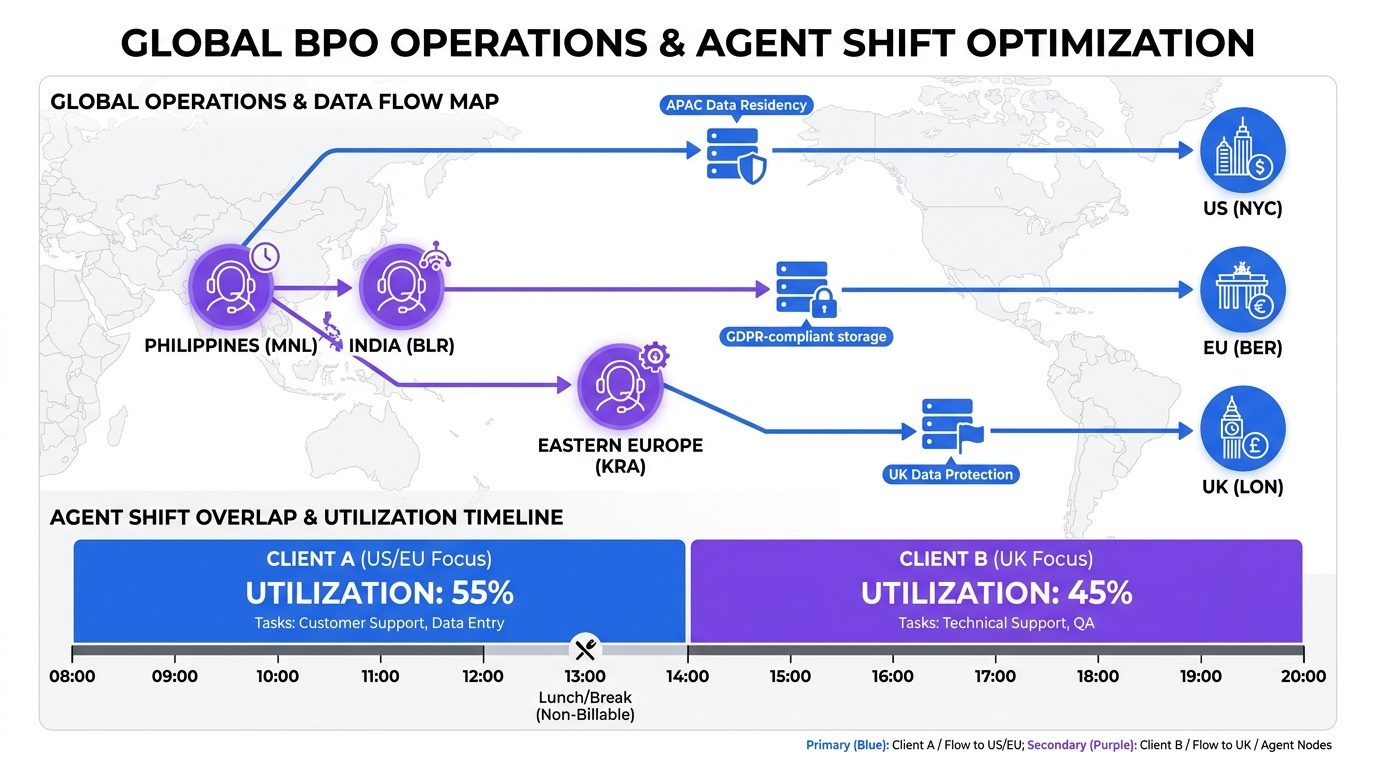
Operating across multiple geographies introduces complexity that basic monitoring tools cannot handle. Key challenges include attributing time correctly when agents serve multiple clients in one shift, managing data residency to comply with regulations like GDPR, and configuring client-specific monitoring policies. These issues often surface after a tool is already deployed.
Once you operate across time zones and regulatory jurisdictions, “one policy for everyone” stops working. You need per-client policy configurations, shift-aware analytics, and jurisdiction-specific data handling. Many tools still treat every agent the same, regardless of which client they are serving or which privacy regime governs that work.
Shift overlap is the edge case most teams only discover after a client asks the wrong question. When one agent serves two clients in a day, how is utilization attributed? If an agent splits time across multiple client accounts, for example spending several hours on Client A workflows and several hours on Client B workflows, both clients need clean reporting. Tools that roll everything up at the agent level, without client-account segmentation, cannot answer it. That gap shows up in audits, not vendor demos.
Data residency across geographies is the other requirement vendors tend to gloss over. A Philippines-based BPO serving EU clients needs monitoring data stored in EU-compliant infrastructure. If a vendor only offers US-based servers, you have created a GDPR exposure for that client relationship. Validate residency options in the vendor’s security documentation, not the marketing site. For teams working through how to choose employee work monitoring software at enterprise scale, data residency is a hard filter, not a tie-breaker.
Ready to streamline your operations? Book a Demo with Flowace today.
Flowace is built for BPO complexity. Manage multi-client policies, attribute time accurately across shifts, and meet data residency requirements.
Building Your Scoring Model: A Step-by-Step Process
A defensible recommendation requires a structured scoring model. The process involves assigning weights to evaluation categories based on your BPO’s priorities (e.g., compliance-heavy vs. SLA-heavy), scoring vendors against specific criteria during demos, and calculating a final weighted score. This data-driven approach ensures the chosen tool aligns with your most critical business needs.
Step 1: Assign Category Weights by Stakeholder Priority
Example weightings for three BPO profiles:
- Healthcare BPO (compliance-heavy): Compliance 35% / SLA Tracking 25% / Deployment 20% / QA Enablement 10% / Agent Experience 5% / Reporting 5%
- Customer Support BPO (SLA-heavy): SLA Tracking 35% / Agent Experience 20% / QA Enablement 20% / Reporting 10% / Deployment 10% / Compliance 5%
- Back-Office Processing BPO (QA-heavy): QA Enablement 35% / SLA Tracking 20% / Compliance 20% / Deployment 10% / Reporting 10% / Agent Experience 5%
Step 2: Score Vendors During Structured Demos
Walk into demos with a scenario and keep the vendor on it. Do not let the session drift into a best-case tour. Give every vendor the same three tests: a simulated SLA breach that demands a real-time response, a QA investigation into a workflow with elevated error rates, and a compliance audit request that requires export for a specific client and date range. Put SLA, QA, and compliance in the same session. The conflicts you need to resolve show up immediately when all three are in the room.
Step 3: Calculate Weighted Scores and Pressure-Test the Winner
Then pilot the top-scoring vendor in a realistic production environment. Use the pilot to answer three questions. Are we meeting SLAs with the data this tool provides? What QA gaps is it actually surfacing? Can we prove compliance if a client asks for an audit tomorrow? If the tool cannot answer all three, it is not ready for your operation, no matter how well it presented in the demo. Explore customer case studies to see how BPO and operations teams apply these capabilities in real environments.
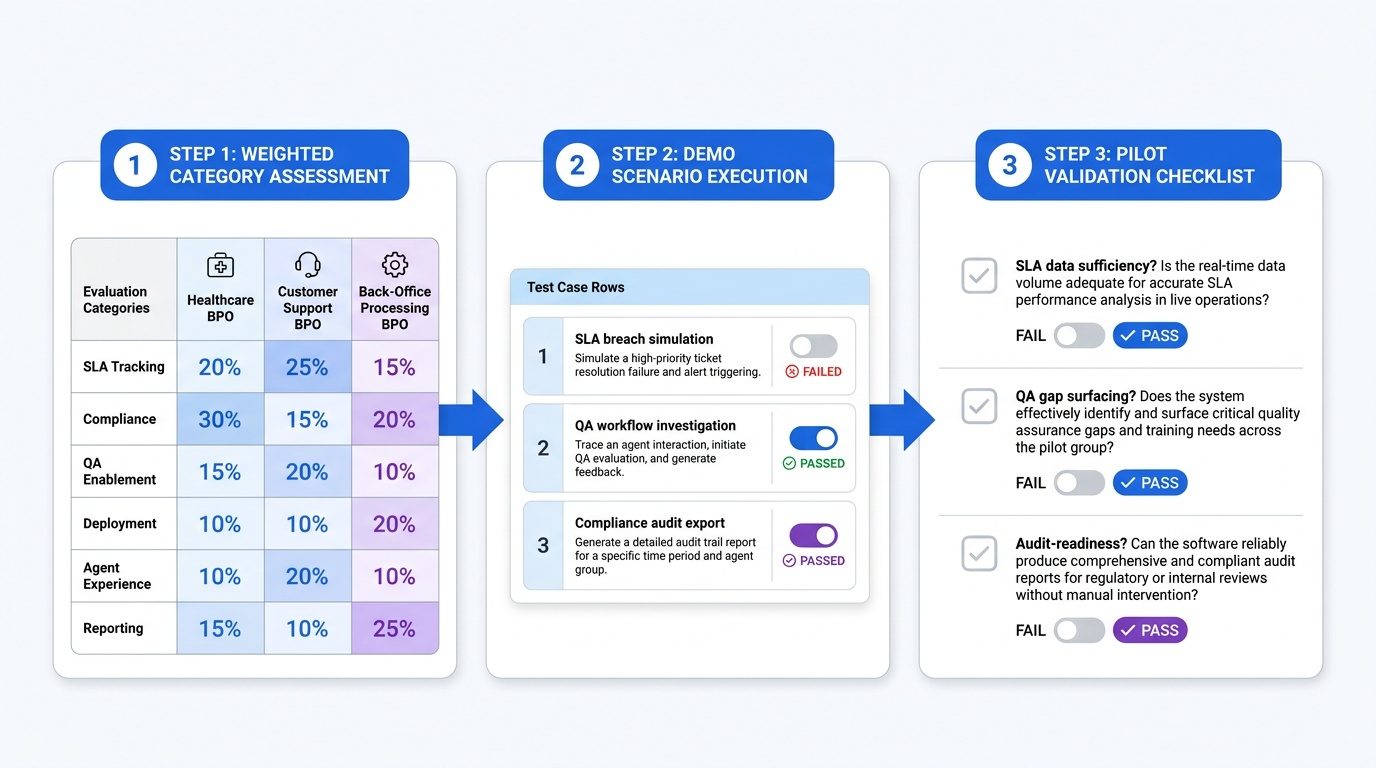
Flowace helps BPO teams understand workload distribution, focus patterns, capacity utilization, and client-specific performance trends without relying on surveillance-heavy practices such as continuous screenshots or keystroke logging.
Making a Defensible Monitoring Software Decision
The three-lens framework (SLA, QA, compliance) is the spine of any credible BPO monitoring evaluation. Each lens brings different data requirements, different latency tolerances, and different compliance implications. Ignore one and you will buy a tool that works for one team while creating problems for the other two.
Monitoring should produce operational intelligence, not surveillance theater. That is not a philosophical distinction; it is an operational one. Surveillance-first tools create distrust, accelerate attrition, and then quietly erode the SLA performance they were purchased to defend. Signal-first tools give managers the inputs they need to respond faster and manage capacity with more confidence.
Your next step is to adapt the 28-point checklist to your BPO’s profile. Set category weights based on your client mix and regulatory exposure, assemble a cross-functional evaluation team (spanning SLA, QA, and compliance), and run structured demos. Keep the process tight. The longer an evaluation drags on, the more likely it ends with IT selecting a tool that answers the wrong questions.
Evaluate BPO Monitoring Without Guesswork
Start Free TrialFrequently Asked Questions on BPO Employee Monitoring Software
1. What is the difference between employee monitoring software and workforce analytics for BPOs?
Employee monitoring software records activity data such as screenshots, keystrokes, URLs, and application usage logs. Workforce analytics turns that stream into operational signal: utilization patterns, focus time distributions, capacity gaps, and workflow completion rates. BPOs benefit from the analytics layer because it supports decisions, not just documentation. Raw activity data creates volume; operational signals drive action. IT services and BPOs represent a significant portion of the employee monitoring software market.
2. Can BPO employee monitoring software track time across multiple client accounts simultaneously?
Top tools support multi-client time segmentation, so utilization can be attributed per client account inside a single agent’s workday. Many general workforce trackers do not do this out of the box. It typically requires the product to recognize client-specific application environments or project tags and split time accordingly. If you run multiple client accounts on shared capacity, treat this as a must-have, not a nice-to-have.
3. What compliance certifications should BPO monitoring software have for healthcare and financial services clients?
SOC 2 Type II is the baseline for enterprise contracts. Healthcare BPOs need HIPAA-compliant data handling, and financial services BPOs need PCI-DSS readiness. For EU client work, GDPR data residency and lawful-basis documentation are required. Under the GDPR, monitoring must have a lawful basis such as legitimate interests, and that basis must be balanced against employee privacy rights. Confirm certifications and controls in the vendor’s security documentation, not the marketing pages.
4. How do you measure ROI on BPO employee monitoring software?
Track ROI against four variables: SLA breach frequency before and after deployment, QA rework rates tied to improved workflow visibility, compliance audit preparation time, and agent attrition rates. In BPO environments, the ROI case is strongest when the tool reduces SLA breach penalties and compliance audit costs, both of which can be measured against contract terms.
5. Does monitoring software increase or decrease agent attrition in BPO environments?
It depends on deployment and communication. Surveillance-style monitoring with heavy screenshots and little transparency tends to increase attrition. Workforce analytics tools that give agents visibility into their own performance data, and position monitoring as operational support rather than oversight, tend to be neutral to positive. BPO attrition already runs at 30 to 40 percent annually, according to NASSCOM 2023. A tool that pushes that number higher undercuts the capacity it was meant to protect.