What Is Schedule Adherence in a Call Center?



Most call centers track schedule adherence. Very few know if their number is actually good.
A score of 85% might be excellent for one floor and a warning sign for another, depending on the team type and how the number is measured.
Schedule adherence is the percentage of scheduled time an agent spends doing what their schedule says they should be doing, logged in, on queue, working.
This article covers the formula, what your benchmark should be, how BPO teams measure it differently, and five steps to improve it, including a real cost calculation you can take to leadership.
What Is Schedule Adherence And Why Does Your Call Center Number Matter?
Schedule adherence measures how closely an agent’s actual working time matches their assigned schedule. It answers one question whether the agent was where they were supposed to be, when they were supposed to be there.
The operational stakes are bigger than most managers assume. A 5% drop in adherence across a 50-agent team works out to roughly 100 lost working hours a week, time you scheduled, budgeted, and paid for, that produced zero output. Multiply that by 52 weeks and the number gets hard to ignore.
But before you can fix your adherence score, you need to know exactly what’s being measured and what isn’t. Most teams get confused because adherence and compliance are often used interchangeably, but they actually measure different things.
What’s the Difference Between Schedule Adherence and Schedule Compliance?
The difference between adherence and compliance in a call center is that adherence measures whether an agent was logged in and available during their scheduled work hours whereas compliance measures whether the agent was doing the correct task at the correct time such as taking calls, completing after-call work, attending training, or taking a scheduled break.
For example, an agent can have 90% adherence but only 60% compliance. This means they were present for most of their shift but were not doing the scheduled task much of the time.
In short, adherence measures attendance to the schedule, while compliance measures following the schedule correctly. Tracking both provides a complete view of workforce performance.
This question shows up constantly in call center forums, and most guides never answer it cleanly.
| Metric | What it Measures | Typical Target Range |
| Schedule adherence | Presence during scheduled hours | 85 to 90% |
| Schedule compliance | Correct activity at the scheduled time | 80 to 85% |
How To Calculate Schedule Adherence?
Schedule adherence is calculated using this formula:
| Schedule Adherence % = (Actual Time on Schedule ÷ Total Scheduled Time) × 100 |
For example, an agent is scheduled for 480 minutes and spends 408 minutes doing scheduled work.
(408 ÷ 480) × 100 = 85% schedule adherence
Actual time on schedule includes productive activities such as calls, after-call work (ACW), and approved AUX codes. It does not include late logins, early logouts, unplanned breaks, or incorrect AUX code usage.
Accurate activity tracking is important because incorrect classifications can make adherence results misleading.
Here’s how it plays out for one agent.
Say an agent is scheduled for 480 minutes in a shift. Their actual time on schedule, meaning calls, after-call work, and approved aux codes comes to 408 minutes. Divide 408 by 480, multiply by 100, and you get 85%, which lands inside the industry target range.
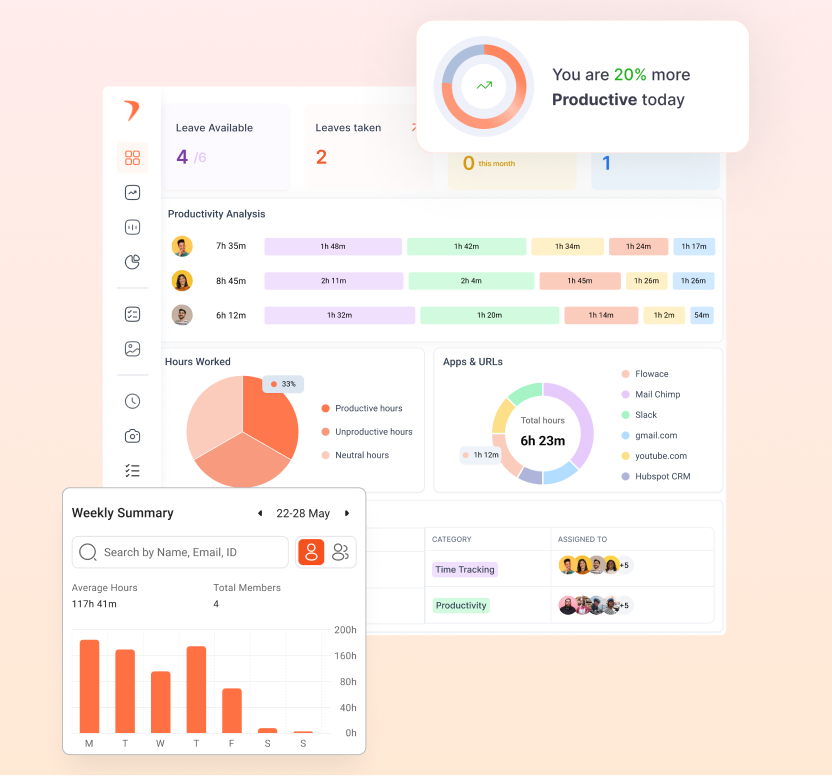
Flowace tracks schedule adherence in real time without any manual work
Book a DemoWhat Is a Good Schedule Adherence Rate?
| Adherence rate | Performance signal | Action |
| 90 to 100% | Excellent | Sustain, check for gaming |
| 85 to 89% | Industry standard | Maintain |
| 80 to 84% | Watch closely | Investigate root causes |
| 75 to 79% | Performance risk | Immediate action plan |
| Below 75% | Critical | Structural scheduling issue |
According to ICMI’s contact center benchmark research, the industry standard for schedule adherence in inbound call centers sits at 85 to 90%. A score above 95% deserves a second look too. It can mean a genuinely disciplined team, or it can mean agents are gaming the metric by sitting idle in a productive-looking aux code.
Schedule Adherence Benchmarks For BPO Teams
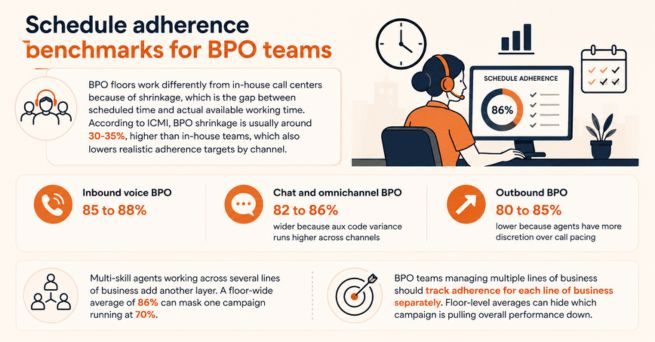
Recommended schedule adherence benchmarks for BPO teams are:
- Inbound voice: 85-88%
- Chat and omnichannel: 82-86%
- Outbound: 80-85%
According to ICMI, BPO shrinkage is typically higher than in-house call centers, around 30-35%. This reduces the amount of time agents are available to handle customer interactions and affects realistic adherence targets.
If your BPO supports multiple clients or lines of business, track schedule adherence separately for each campaign. A floor-wide average can hide poor adherence in one team, making it harder to identify and fix performance issues.
What Causes Low Schedule Adherence In Call Centers?
The most common causes of low schedule adherence in call centers are:
- Poor workforce forecasting: Too few or too many agents are scheduled for the expected call volume.
- No real-time monitoring: Agents often don’t realize they are off schedule until their shift has ended.
- Schedules that ignore shrinkage: Breaks, training, meetings, and other planned activities are not included when creating schedules.
- Unclear AUX code policies: Agents may select the wrong status codes, making adherence data inaccurate.
- Limited coaching and feedback: Without regular reviews, agents are less likely to improve their adherence.
Fixing these issues helps agents follow their schedules more consistently and improves overall call center performance.
How To Improve Schedule Adherence in a Call Center?
Here are the 5 steps to improve schedule adherence in a call center:
Step 1: Show Agents Their Own Adherence Data Every Week
Most agents who miss their targets don’t even realize it. A weekly individual report, not just a manager dashboard, helps close that gap.
Teams that give agents their own reports usually see better adherence within four weeks.
Step 2: Run a Shrinkage Audit Before You Touch the Schedule
Check shrinkage for each team before blaming agents. If it is above 35%, the issue is likely in the schedule rather than the people.
Include shrinkage in planned hours going forward. ICMI says BPO shrinkage is usually 30-35%.
Step 3: Set Up Real-Time Intraday Alerts Instead Of End-Of-Day Reports
By the time an end-of-day report shows a problem, the shift and the revenue are already lost. Real-time alerts help supervisors act while the agent is still working. Aim to fix issues within 15 minutes.
That’s why many teams rely on real-time workforce visibility instead of waiting for end-of-day reports.
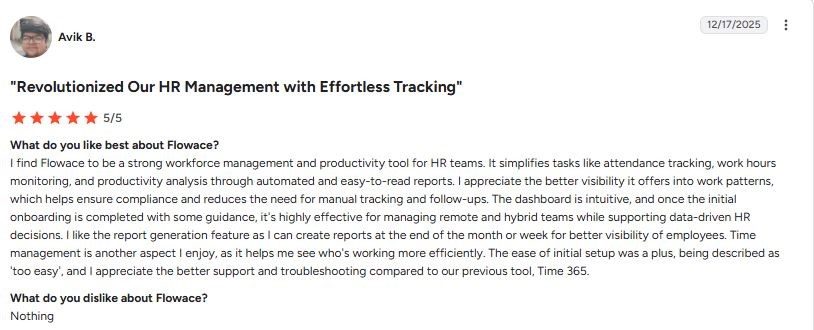
One G2 reviewer, Avik B., shared that Flowace‘s automated reports and intuitive dashboard made attendance tracking, work hour monitoring, and productivity reporting much easier. He also noted that the added visibility reduced manual follow-ups and simplified managing remote and hybrid teams.
Step 4: Fix Your Aux Code Policy
Audit every break and aux code on a weekly basis and remove any catch-all code that gives agents an easy place to hide idle time. Every situation an agent hits during a shift should have one clear, specific code, so there’s never a reason to reach for a vague one.
Step 5: Track Adherence By Agent Level
A floor average can look fine even if a few agents are performing poorly. Tracking each agent individually helps you see the real issue and have clear one-on-one conversations instead of general team warnings.
This is the same idea as measuring call center agent productivity beyond call counts, since floor averages rarely show the real problem.
These five steps are easier to follow when adherence tracking, alerts, and reporting are automated. Like other productivity management techniques, they work best when they’re part of a consistent weekly routine rather than a one-time policy change.
Track schedule adherence automatically with Flowace
Free 7-Day TrialFrequently Asked Questions On Schedule Adherence In A Call Center
1. What is schedule adherence?
Schedule adherence is the percentage of an agent’s scheduled shift they actually spend working, logged in, on queue, or doing an approved task.
2. How to calculate schedule adherence in a call center?
It’s calculated as actual time on schedule divided by total scheduled time, multiplied by 100. For example, 408 minutes worked out of a 480-minute shift equals 85% adherence.
3. What is a good schedule adherence rate?
Most inbound call centers target 85 to 90% adherence based on ICMI’s contact center benchmark data. Anything below 80% typically signals a scheduling or engagement problem worth investigating.
4. How do you calculate schedule adherence in a BPO?
The formula is the same as any call center. Actual time on schedule divided by scheduled time, times 100. BPO targets run slightly lower, 82 to 87%, because shrinkage from multi-skill routing and channel switching runs higher than in-house floors.
5. How to improve schedule adherence in a call center?
These five steps work best together. Show agents their weekly adherence data, audit shrinkage before changing schedules, set up real-time intraday alerts, fix vague aux codes, and track adherence at the individual level instead of the team average.
6. Is schedule adherence a KPI?
Yes. According to the Talkdesk CX Report 2023, 74% of call centers rank schedule adherence as a top 3 key performance metric, along with average handle time and first-contact resolution.
7. What causes low schedule adherence in call centers?
The most common causes are poor forecasting that leads to understaffing, no real-time visibility into off-schedule events, schedules built without shrinkage built in, unclear aux code policies that get misused, and no weekly feedback loop showing agents their own numbers.
8. What tools track schedule adherence automatically?
Workforce management tools like Flowace track adherence using live agent activity instead of manual timestamps. They flag off-schedule events in real time so supervisors can act during the shift, not the next day.
9. What is the difference between schedule adherence and schedule conformance?
Adherence measures whether an agent worked at the exact times their schedule specified. Conformance measures whether they worked the same total number of hours, even if the timing shifted. For example, taking a break an hour later than planned. An agent can hit conformance while missing adherence.