What Is Back Office BPO? Operations, Challenges & Productivity




Back office BPO is the outsourcing of internal business tasks to a third-party service provider. These tasks support daily business operations but do not involve direct customer interaction.
Common examples include data entry, payroll, accounting, claims processing, and document management. Businesses use back office BPO to reduce costs, improve efficiency, and free internal teams to focus on core work.
This article explains how back office BPO operations work, the biggest outsourcing challenges, and the key metrics businesses use to measure productivity and outsourcing success.
Back Office BPO Vs Front Office BPO At A Glance
|
Aspect |
Back Office | Front Office |
|
Customer contact |
None |
Direct, ongoing |
| Example work | Data entry, payroll, claims, IT support |
Sales calls, live chat, support tickets |
|
Revenue role |
Supports revenue indirectly | Drives revenue directly |
| Main metrics | Turnaround time, error rate, cost per transaction | Handle time, first contact resolution, CSAT |
| Client visibility | Low. Work happens behind the scenes |
High. Customer sees the work happen |
What Is Back Office BPO?
Back office BPO is the outsourcing of internal business tasks to a third-party provider. These tasks support daily business operations but do not involve direct customer interaction.
Common back office BPO services include data entry, payroll, accounting, HR support, claims processing, and IT support.
Why Do Businesses Use Back Office BPO?
Businesses use back office BPO to reduce costs, improve efficiency, and give internal teams more time to focus on core business activities. It also helps companies access specialized skills, scale operations, and improve business performance.
Back Office BPO vs. Front Office BPO
Back office BPO supports internal business operations behind the scenes. Front office BPO handles customer-facing work such as sales, customer service, and technical support.
The two are measured differently. Front office teams are often measured by response time and customer satisfaction. Back office teams are measured by accuracy, quality, turnaround time, and productivity.
|
Back Office BPO |
Front Office BPO |
| Internal business tasks |
Customer-facing tasks |
|
Data entry, payroll, accounting |
Sales, customer support, technical support |
| Measured by accuracy, quality, turnaround time, and productivity |
Measured by response time and customer satisfaction |
What Are The Common Back Office BPO Services?
Most back office BPO providers offer:
- Finance and accounting: Bookkeeping, invoice processing, and accounts payable and receivable.
- Data entry and document processing: Converting paper or scanned files into digital records.
- HR administration and payroll: Employee onboarding, attendance tracking, payroll, and HR records.
- Claims processing: Reviewing and processing insurance and healthcare claims.
- IT support: Helpdesk services, ticket management, user access, and basic technical support.
- Compliance support: Preparing business records for financial, legal, and regulatory requirements.
Insurance companies often use back office BPO because claims processing involves large volumes of documents and detailed reviews.
Learn more in our guide to Insurance BPO Services.
How Does Back Office BPO Work?

Most back office BPO work follows a four-step process. These are intake, processing, quality checks, and reporting.
Whether the task is invoice processing, claims review, payroll support, or data entry, the basic workflow remains the same.
The Back Office BPO Workflow Step by Step
- Intake: The provider receives work from the client as files, tickets, forms, or records. Work may arrive in batches or throughout the day.
- Processing: The team enters, updates, reviews, or verifies information by following the client’s instructions and business rules.
- Quality Check: A QA analyst or automated system reviews completed work to find and fix errors before delivery.
- Reporting: The provider shares reports on completed work, turnaround time, accuracy, and other agreed performance metrics.
Each step should have a clear owner. Defined responsibilities help reduce errors, improve quality, and keep work moving on schedule.
What Are the Key Roles in a Back Office BPO Team?
Most back office BPO teams rely on four core roles:
- Process Associate: Completes daily tasks such as data entry, document processing, and record updates while following client instructions.
- Quality Assurance (QA) Analyst: Reviews completed work to check accuracy, quality, and compliance with requirements.
- Team Lead: Assigns tasks, tracks daily progress, manages attendance, and handles team-level issues.
- Operations Manager: Oversees overall performance, manages the client relationship, and helps the team meet service goals.
5 Common Back Office BPO Challenges and How to Fix Them

Back office BPO teams commonly face five challenges: data security risks, employee turnover, quality issues, time zone differences, and limited visibility into daily work.
Each challenge has practical ways to reduce the impact.
1. Data Security and Compliance Risk
Back office teams handle sensitive business and customer data every day. This can include payroll records, financial information, employee details, and customer files. A data breach can cause financial loss, legal issues, and damage to customer trust.
The fix: Choose a provider with strong security practices. Check for standards such as ISO/IEC 27001. For businesses handling personal data in India, ensure compliance with the Digital Personal Data Protection Act, 2023. Include audit rights in the contract and use data protection measures when needed.
2. High Employee Turnover and Skill Gaps
Back office BPO teams can experience frequent employee changes. When experienced team members leave, new employees need time to learn processes, which can slow productivity and increase errors.
The fix: Create a clear onboarding process, provide regular training, and support employee retention through career growth and performance programs.
3. Quality Control Across Distributed Teams
Maintaining consistent quality can be challenging when work is handled by an external team. Errors in invoices, claims, or records can create delays and additional costs.
The fix: Set clear quality standards, review completed work regularly, and track error rates with the provider.
4. Communication and Time Zone Differences
Teams working across different time zones may have fewer shared working hours. Delayed responses can slow decisions and daily operations.
The fix: Use clear handoff notes, shared dashboards, and scheduled overlap hours for important discussions.
5. Limited Visibility Into Daily Work
Clients may struggle to understand how work is progressing each day. Attendance data alone does not show task completion, time spent on work, or where delays happen.
The fix: Use productivity metrics and reporting tools to track workload, progress, quality, and turnaround time.
Hidden delays hurt BPO output. Flowace helps you find productivity gaps.
View Productivity InsightsHow Much Does Back Office BPO Cost?
Back office BPO typically costs $8 to $25 per hour depending on location, process complexity, skill level, and service requirements.
According to Site Selection Group’s 2025 Business Process Outsourcing Global Pricing Guide, BPO costs vary based on delivery location, work type, technology needs, security requirements, and operating model.
At 160 working hours per month, this equals roughly $1,280 to $4,000 per month per full-time employee (FTE).
Basic services like data entry and document processing usually cost less. Specialized services such as finance, compliance, and technical support often cost more due to higher skill requirements.
Businesses should compare providers using cost, accuracy, turnaround time, security, and service quality rather than hourly rates alone.
How to Track Productivity in Back Office BPO?

Back office BPO productivity is measured using five key metrics. These are turnaround time, error rate, cost per correct job, utilization rate, and SLA adherence.
These metrics show how quickly, accurately, and efficiently an outsourced team completes work.
APQC’s process benchmarking research highlights performance measures such as cycle time, cost, quality, and productivity for improving business operations.
The Five Most Important Back Office BPO Productivity Metrics
- Turnaround time (TAT): The time required to complete a task from start to finish. Lower TAT usually means faster delivery.
- Error rate: The percentage of completed tasks that require corrections or rework. Lower error rates indicate better quality.
- Cost per correct job: The total cost divided by the number of tasks completed correctly the first time. This shows the real cost of accurate delivery.
- Utilization rate: The percentage of paid working hours spent on productive tasks. Balanced utilization helps teams maintain output and quality.
- SLA adherence: The percentage of tasks completed within the agreed timeline and quality standards.
Flowace BPO Productivity Benchmarks
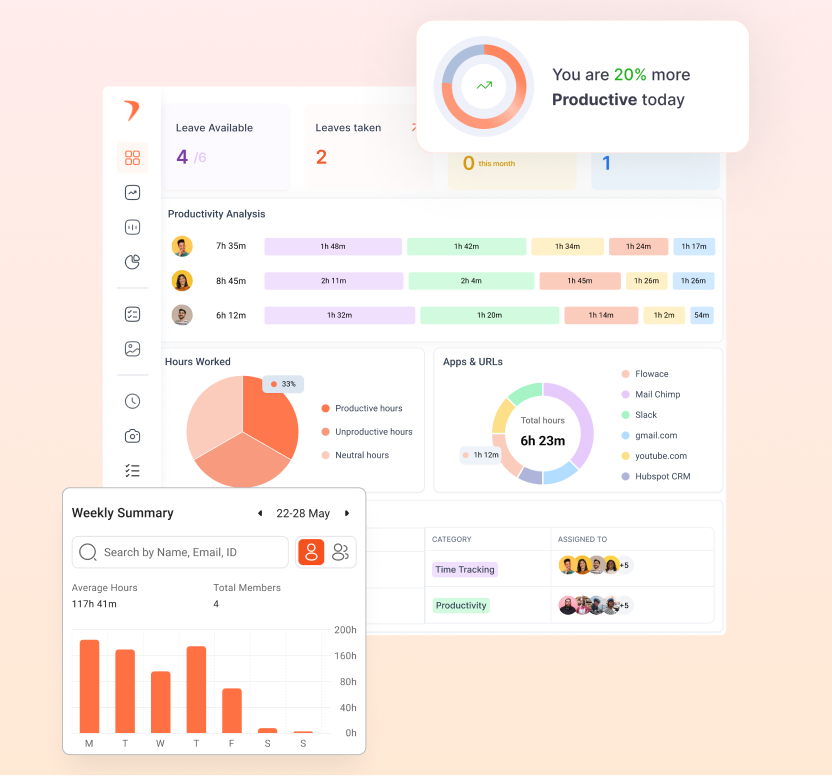
Flowace helps BPO and managed service teams track productivity using metrics such as active hours, productive time, utilization, and workload visibility.
Customer case studies show how teams use productivity insights to improve operational visibility.
For example, one enterprise managed services customer maintained 93%+ productivity across 378 users during a scale-up period. Another analytics services company maintained 94-95% productivity across three quarters after improving visibility into delivery operations.
These results come from individual customer deployments and should be viewed as examples rather than industry-wide averages.
Methodology: Figures are based on customer case studies and productivity insights shared by Flowace. Results may vary based on team size, process type, workload, business goals, and operating model.
Learn more about related BPO performance measurements in our guide to BPO call center KPIs.
The Productivity Formula Back Office BPO Teams Use
The basic productivity formula is:
Output ÷ Hours Worked = Productivity Rate
For example, if a team completes 400 invoices in 50 hours, the productivity rate is 8 invoices per hour.
A higher productivity rate means more completed work in less time. Tracking this number over time helps teams identify trends, compare performance, and improve operations.
Manual vs Automated Ways to Track Productivity
Back office teams usually track productivity in two ways.
- Manual tracking: Teams use spreadsheets and timesheets to record work. This method is simple to start but can take more time and make detailed reporting harder.
- Automated tracking: Workforce analytics software collects work data, creates reports, and shows productivity patterns. This gives managers better visibility into workload, time usage, and possible delays.
Workforce analytics tools like Flowace help teams track productivity, understand work patterns, and improve operational visibility.
How to Choose a Back Office BPO Partner?
Choosing the right back office BPO partner starts with checking five key areas:
- Security and certifications: Confirm the provider follows security standards such as ISO 27001 and meets industry requirements.
- Reporting: Ask how often you will receive SLA reports, quality data, and performance updates.
- Pilot period: Test a small batch of work before signing a long-term contract. This helps evaluate quality, speed, and communication.
- Cost model: Compare the cost per completed task, accuracy, and rework costs instead of looking only at hourly rates.
- Visibility tools: Check how the provider tracks output, quality, and productivity. Attendance data alone does not show complete performance.
Still comparing providers? Explore our list of the top 25 BPO companies to understand key factors to consider when building your shortlist.
Frequently Asked Questions About Back Office BPO
1. What is back office BPO?
Back office BPO is the outsourcing of internal business tasks to an external service provider. Common examples include data entry, payroll, accounting, claims processing, and IT support. Companies use it to reduce workload, improve efficiency, and let internal teams focus on core business activities.
2. What is the difference between back office and front office BPO?
Back office BPO handles internal tasks such as data processing, payroll, and document management. Front office BPO handles customer-facing activities such as sales and customer support. Back office teams are usually measured by accuracy and turnaround time, while front office teams focus more on response time and customer satisfaction.
3. What are the biggest challenges in back office BPO operations?
The biggest back office BPO challenges include data security risks, staff turnover, quality issues, time zone differences, and limited visibility into daily work. Companies manage these challenges through security checks, employee training, quality reviews, and productivity tracking.
4. How do you measure productivity in a back office BPO team?
Back office BPO productivity is measured using metrics such as turnaround time, error rate, cost per correct job, utilization rate, and SLA adherence. These metrics show how quickly, accurately, and efficiently a team completes work.
5. What tools are used to track back office BPO productivity?
Teams use spreadsheets, timesheets, and workforce analytics software to track productivity. Automated tools collect work data, create reports, and show performance patterns. Platforms like Flowace combine productivity insights, attendance data, and activity tracking to improve operational visibility.
6. How do I choose the right back office BPO provider?
Choose a back office BPO provider by evaluating security standards, service quality, reporting, pricing, and productivity tracking methods. A small pilot project can help you review quality, speed, and communication before signing a long-term agreement.