What Is an SME in BPO? Meaning, Roles & Responsibilities




An SME in BPO (Subject Matter Expert) is an experienced agent who helps resolve complex customer issues, supports teammates, and shares process knowledge. Agents usually turn to an SME when a problem cannot be solved using standard scripts or knowledge base articles.
SMEs support daily operations by answering questions, handling escalations, coaching agents, and improving process accuracy. They work closely with both frontline agents and team leaders.
This article explains the responsibilities, skills, KPIs, career path, and salary of an SME in BPO.
SME vs Team Leader vs QA Analyst in BPO
An SME, a team leader, and a QA analyst all support the same floor, but each one owns a different piece of it.
The table below compares the reporting lines, headcount ownership, core focus, and escalation point for all four roles. It also includes the agent role to show where each role’s responsibilities begin.
| Role | Reports To | Owns Headcount | Core Focus | Escalation Point |
| Agent | Team Leader | No | Handles customer interactions directly | Routes unresolved issues to the SME |
| SME | Team Leader | No | Process knowledge, coaching, and escalation handling | Takes queries agents cannot resolve alone |
| Team Leader | Operations Manager | Yes | Shift management, attendance, and performance reviews | Handles people and scheduling issues |
| QA Analyst | QA Manager | No | Call and interaction scoring, compliance checks | Flags quality and compliance gaps |
What Does SME Stand for in BPO?
SME stands for Subject Matter Expert. An SME is the team member with the deepest knowledge of a specific account, product, or process. Other agents rely on them for guidance when they face complex customer issues or need help with a task.
The full form of SME in BPO is used the same way across customer service, technical support, back-office, and finance and accounting teams.
The SME role exists across every major BPO hub, from the top BPO companies in the world down to small regional accounts. That’s because every team eventually faces customer issues that go beyond what a script or knowledge base can solve.
An SME does more than answer questions. They also identify recurring issues, improve processes, and help turn common problems into standard ways of working.
Where Does an SME Sit in the BPO Team Structure?
An SME usually sits between a customer service agent and a team leader in the BPO team structure.
Agents first escalate complex or unusual customer issues to the SME. If the issue is related to people, policy, or approvals, the SME passes it to the team leader.
This position defines the SME’s responsibilities. An SME owns process knowledge, not people management. They do not approve leave, conduct performance reviews, or make hiring decisions. Instead, they solve process-related issues, guide agents, and decide when an issue needs to be escalated to the team leader.
What Does an SME in BPO Do Every Day?
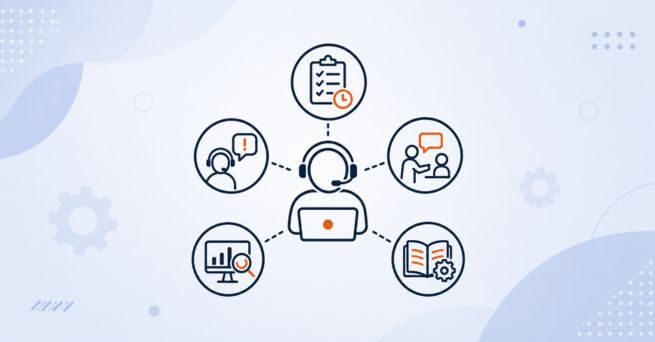
A typical SME spends the day solving complex issues, supporting agents, checking quality, and improving team processes. Most shifts include these five responsibilities:
- Morning briefing. Review overnight escalations, client updates, and process changes before the shift starts.
- Handle escalations. Resolve customer issues that agents cannot solve on their own.
- Coach agents. Support new hires and help team members improve through real customer cases.
- Review quality. Check calls or tickets to make sure agents follow the correct process.
- Update documentation. Add new solutions to the knowledge base so future issues can be resolved faster.
Much of an SME’s work happens behind the scenes. They may spend less time talking to customers, but they help improve quality, reduce repeat issues, and support the team every day.
Your SMEs solve problems every day. Your dashboard should show that impact.
See It in ActionWhat Are the Core Responsibilities of an SME in BPO?
An SME in BPO is responsible for training agents, handling complex issues, improving processes, and supporting daily operations. These responsibilities usually fall into six main areas:
- Training and onboarding support. Helping new agents learn processes through real examples and guidance.
- Escalation handling. Resolving customer issues that agents cannot solve using standard scripts.
- Quality support. Working with QA teams to maintain consistent service standards.
- Knowledge base updates. Creating and improving documents that help agents solve problems faster.
- Client and team communication. Sharing process updates with agents and reporting recurring issues to leaders.
- Process improvement. Identifying repeated problems and suggesting solutions before they impact service levels.
Most managers know what SMEs should handle. The bigger challenge is knowing how consistently these responsibilities happen across every shift, account, and team member.
What Skills Does an SME Need in BPO?
A strong SME in BPO needs a mix of process knowledge, communication skills, problem-solving ability, and the ability to support agents under pressure. These skills help SMEs handle complex issues and improve team performance.
- Deep process knowledge. An SME should understand the workflow, common issues, and unusual cases better than other agents.
- Clear communication. SMEs need to explain solutions clearly when coaching agents or handling difficult situations.
- Patience under pressure. SMEs often handle the most challenging problems while supporting agents and customers.
- Problem-solving skills. They identify repeated issues and find ways to improve processes.
- Time management. SMEs balance escalations, coaching, and documentation during the same shift.
What KPIs Measure SME Performance in BPO?
SME performance in BPO is measured using KPIs that show how well an SME supports agents, solves complex issues, and improves team processes. These metrics focus on the impact of SME work, not just attendance or activity.
- Escalation resolution time. Measures how quickly an SME solves complex queries from start to finish.
- Knowledge base accuracy and updates. Tracks whether process documents stay correct and useful for agents.
- Coaching hours. Measures the time an SME spends training and supporting agents.
- Agent quality score improvement. Shows how much an agent’s performance improves after SME support.
These sit alongside a standard set of BPO call center KPIs, but SME performance should be tracked separately. When SME contributions are mixed into general team results, their real impact becomes harder to see.
What Challenges Do SMEs Face in BPO?
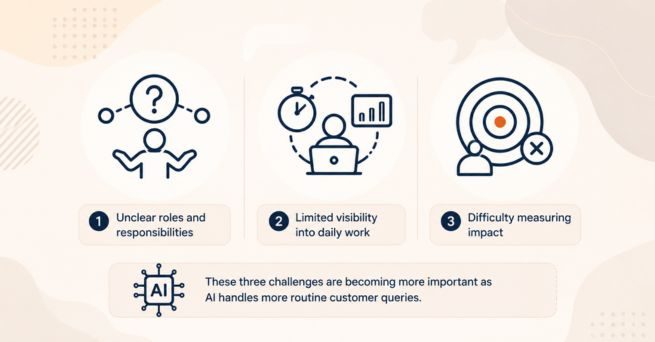
SMEs in BPO face three common challenges. Unclear responsibilities, limited visibility into their work, and difficulty proving their impact. These challenges make it harder for teams to recognize the value SMEs bring to daily operations.
1. Unclear roles and responsibilities
Without a clear job description, SMEs often take on extra tasks from team leaders while managing their own responsibilities.
2. Limited visibility into daily work
An SME’s day includes escalations, coaching, and documentation. Basic attendance reports show working hours but do not show where that time creates value.
3. Difficulty measuring impact
SME contributions are often hard to capture in one metric. Their work prevents repeat issues, improves agent performance, and supports compliance, but these results are not always visible.
These three challenges are becoming more important as AI handles more routine customer queries.
Why the SME Role Is Growing in BPO?
The SME role is becoming more important as the BPO industry expands and handles more complex work.
As companies manage more accounts and complex customer needs, they need experienced employees who can maintain process knowledge, support agents, and improve daily operations.
How Do You Become an SME in BPO?
You can become an SME in BPO by building strong performance as an agent, helping teammates, developing process knowledge, and earning the trust of team leaders. Most SMEs move into the role after proving they can handle complex issues and support others.
- Build a strong performance record. Maintain good quality scores, solve issues accurately, and show consistency in your work.
- Help teammates and share knowledge. Supporting new agents and explaining processes can show your ability to guide others.
- Get recommended by leaders. Many SME promotions happen when team leaders or QA managers recognize an agent’s skills.
- Complete a transition period. New SMEs often shadow experienced SMEs to learn escalation handling and process documentation.
The SME role continues to grow as BPO operations become more complex. As companies handle more accounts and complex issues, they need experienced employees to support agents. These employees help maintain process knowledge across teams.
Your SMEs are solving problems every day. See the work your reports miss.
Book A DemoFrequently Asked Questions On SME in BPO
1. What is the role of an SME in BPO?
An SME’s role in BPO is to be the go-to expert for a specific process, account, or product. They handle escalations agents can’t resolve alone, train new hires on real scenarios, and keep the team’s knowledge base accurate and current.
2. What is a SME in customer service?
In customer service, an SME is an expert who helps solve customer issues that need more knowledge than a standard script provides. They also help define the correct response for tricky or unusual cases.
3. What is the role of an SME in call centers?
In a call center, an SME supports agents through live escalation handling, coaching, and quality checks. They sit closer to the floor than a team leader, with the process depth to resolve issues a script can’t.
4. What is the full form of SME in BPO?
The full form of SME in BPO is Subject Matter Expert. It refers to a specialist with deep knowledge of a specific process or function. The term is used across customer service, technical support, and back-office roles.
5. What is the difference between an SME and a team leader in BPO?
An SME owns process knowledge and handles escalations, but has no direct headcount. A team leader owns people, managing schedules, attendance, and performance reviews for a set group of agents. The two roles work side by side, each covering a different part of the operation.
6. What skills does an SME need in a BPO?
An SME needs strong process knowledge, clear communication skills, patience under pressure, problem-solving ability, good time management to handle escalations, coaching, and documentation during a shift.
7. How do you become an SME in BPO?
Becoming an SME usually starts with strong performance as an agent. A team leader or QA manager often recommends the agent, followed by a shadowing period before they take on the SME role fully.
8. What is the salary of an SME in BPO?
SME pay varies by company, location, and account type. It is usually higher than an agent’s pay but lower than a team leader’s because SMEs take on more process responsibilities. For a detailed breakdown, see our guide to BPO salaries in India.