How to Improve Work Performance



If you’re searching for how to improve work performance, most advice repeats the same tips like goal setting and reducing distractions. But it rarely tells you whether anything actually improved.
Work performance does not improve from advice alone, it improves when output is defined clearly and tracked over time so progress becomes visible.
This article is for employees and managers and it shows a measurable system for improving output including how to set expectations and track whether work performance is actually increasing.
What is work performance?
Work performance is the measurable output a person or team produces relative to set goals, rather than time spent or visible activity.
For employees, it is measured through output quality, on-time delivery, and skill improvement. For managers, it is measured through team throughput, goal completion rate, and blocker resolution speed. The metrics differ but the core question stays the same whether work is producing the intended result.
This is why generic work performance advice fails. Employees need execution systems, and managers need systems that measure and improve output using productivity management techniques.
Why does most work performance advice fail?
Three failure modes explain why most advice on how to improve work performance does not stick.
Vague employee advice does not create a way to measure results. Tips like focus more, use a planner, or take breaks only describe actions. They do not show whether work output actually improved. Without a clear result, it is not possible to know what worked.
Manager advice often stays theoretical. Annual reviews, competency frameworks, and HR templates describe performance in general terms. They do not help managers identify who is stuck or what is blocking output in real time.
Neither approach includes a measurement layer. According to the McKinsey Global Institute, only about 39% of an employee’s workday is spent on primary job tasks. The rest is spent on coordination, communication, and reactive work.
The Asana Anatomy of Work Index shows a similar pattern, where a large share of time goes into meetings, updates, and administrative work instead of core execution.
Different studies point in the same direction. A large portion of work time is spent away from actual output.
If you cannot see where time goes, you cannot improve work performance.
The strategies below fix this by adding one thing, a clear way to measure output.
How can employees improve work performance?
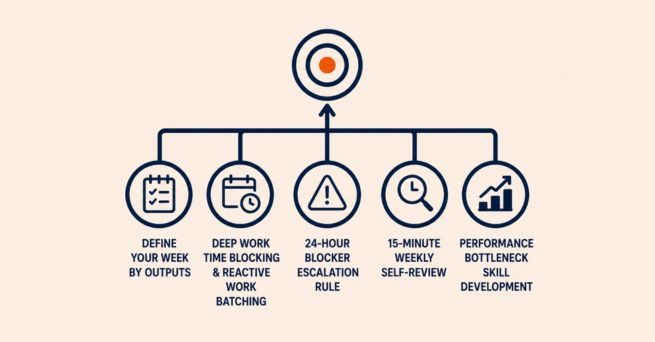
These strategies are for individual contributors. Whether you want to hit your targets faster, improve your next work performance review, or simply feel less scattered at work. Each one is self-directed. You don’t need your manager to implement them.
1. Define your week by outputs
Most to-do lists track activity instead of outcomes. A better approach is to start each week by defining three to five clear outputs that represent success for that week such as draft reviewed or client proposal sent.
This shifts planning from tasks to finished results and forces work to be structured around delivery rather than effort.
At the end of the week the signal becomes clear whether the intended outputs were completed or the week was spent on lower priority work.
Success is measured by how many planned outputs were actually delivered compared to total work done with a target of around 80 percent alignment week over week. Track this during a weekly check-in for consistent review.
2. Deep work time blocking and reactive work batching
Deep work time blocking and reactive work batching separates focused work from interruptions so both are handled without overlap. Research shows workers switch tasks over 25 times per day and lose about 23 minutes of refocus time per switch according to the Asana Anatomy of Work Index 2024.
The method is to block two-hour deep work windows in the morning as fixed focus time with no meetings or communication tools. Reactive work like emails, messages, and approvals is handled in two fixed daily windows so focus time stays protected.
Success is three or more hours of uninterrupted deep work per day tracked manually or through focus time tracking tools.
3. 24-hour blocker escalation rule
24-hour blocker escalation rule is a method for handling stalled tasks before they compound into larger delays. Blockers often create cascading impact across dependent work, and waiting too long to flag them increases total time lost.
The approach is to flag any task that is blocked for more than 24 hours due to dependencies outside your control. This can be done through Slack, standups, or project management tools. The goal is to surface the issue quickly rather than trying to solve it alone.
Success is measured by tracking the average time between a task getting blocked and it being flagged with a target of under 24 hours.
4. 15-minute weekly self-review
15-minute weekly self-review is a method for tracking personal output and blockers so performance is visible over time instead of relying on memory during reviews. Most people lose track of what they delivered within a few weeks which makes performance evaluation harder for both employees and managers.
The process is to spend 15 minutes every Friday answering three questions. What was completed, what is still blocked and why, and what needs to be highlighted to a manager. The answers should be recorded consistently to build a reliable record of weekly output.
Success is measured by week-over-week task completion rate and consistency of delivery. Over time, this creates patterns that show when output drops and what conditions affect performance.
5. Performance bottleneck skill development
Performance bottleneck skill development focuses learning on the single skill that most limits work output. Most professional development fails because it targets interest areas instead of the constraint that slows delivery.
Identify the skill that directly slows your key work such as writing speed or inability to interpret data independently. Spend 30 minutes daily improving only that skill for six weeks.
Success is measured by a 20 to 30 percent reduction in time to complete tasks that depend on that skill within six weeks.
How can managers improve team performance?
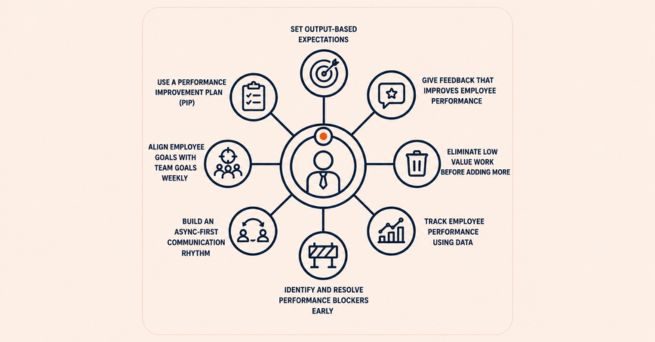
These strategies follow a direct answer on what most managers get wrong, how to implement it, and what success looks like with a specific metric.
1. Set output-based expectations
Output based expectations helps where work performance is defined by measurable results instead of activities. Many teams fail to measure performance correctly because they focus on inputs like meetings, reports, or response time instead of actual outcomes.
The approach is to define clear outputs for each role such as closing a set number of deals, shipping a feature, or reducing ticket backlog by a specific amount. Once outputs are defined, all check ins and feedback are measured against these results rather than perceived effort or activity.
Success is measured by goal completion rate over time. Consistent low completion rates indicate blockers or capacity issues that need to be addressed rather than assumptions about effort.
2. Give feedback that improves employee performance
Feedback that improves employee performance is frequent, specific input on work progress rather than annual reviews. Delayed feedback allows performance patterns to continue for months without correction.
A practical approach is a recurring async check in every two to three days asking what moved forward, what is blocked, and what needs a decision. This can be done in Slack or any work tool and is designed to keep feedback tied to real work instead of formal review cycles.
Gallup research consistently shows that employees who receive meaningful feedback on a weekly basis are significantly more engaged than those who receive it only during formal reviews (Gallup State of the Global Workplace, 2023).
Success is measured by reduction in blocker resolution time, tracked as the average number of days between a blocker being raised and resolved.
3. Eliminate low value work before adding more
Eliminating low value work before adding more focuses on removing activities that do not contribute to output before introducing new processes. Most performance problems come from workflow overload rather than skill gaps.
Start by identifying recurring activities that consume time but don’t directly increase output such as unnecessary meetings, repeated status updates, or approval chains.
The approach is to run a weekly 30-minute audit of team activities. Rank them based on output impact versus effort. Reduce or remove the lowest-value items to protect time for core work.
Success is measured by hours reclaimed per person per week from low-value activities. Even small reductions compound into higher output over time.
4. Track employee performance using data
Tracking employee performance using data measures output and work patterns instead of relying on manager perception.
Perception based management often over weights visible activity such as meetings, messaging, or frequent communication. It underestimates consistent delivery from less visible contributors who may produce steady output without frequent visibility.
The approach is to track objective metrics such as time spent per project versus plan, task completion rate against output goals, and the ratio of focus time to meeting time. These metrics reveal capacity issues, declining output trends, and meetings that consume more time than the decisions they produce.
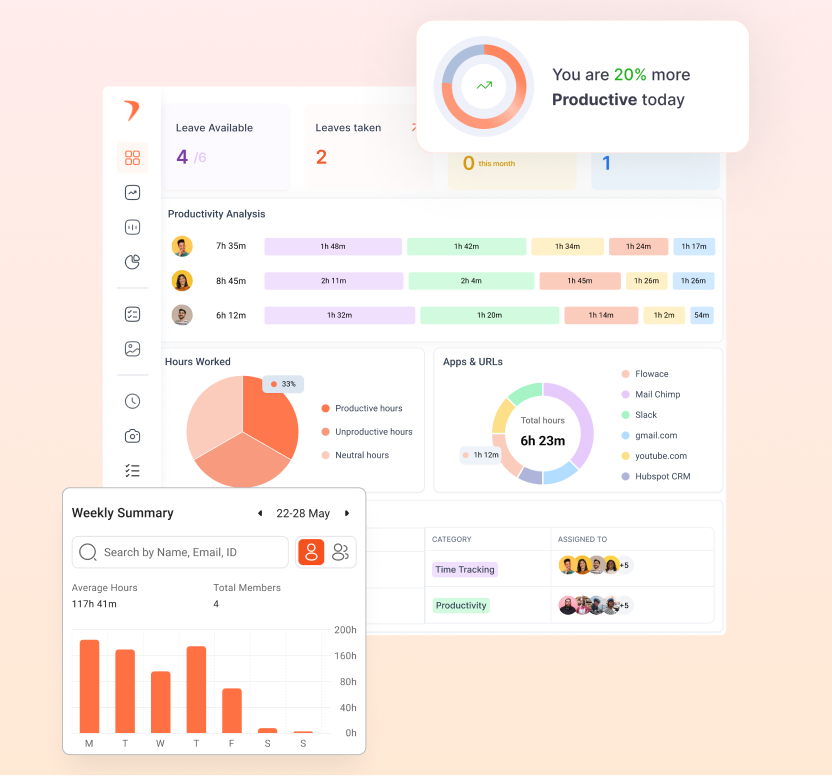
Automated time tracking tools like Flowace collect work activity data without manual timesheets and provide weekly visibility into team capacity and output. This removes reliance on memory based reporting and improves decision accuracy.
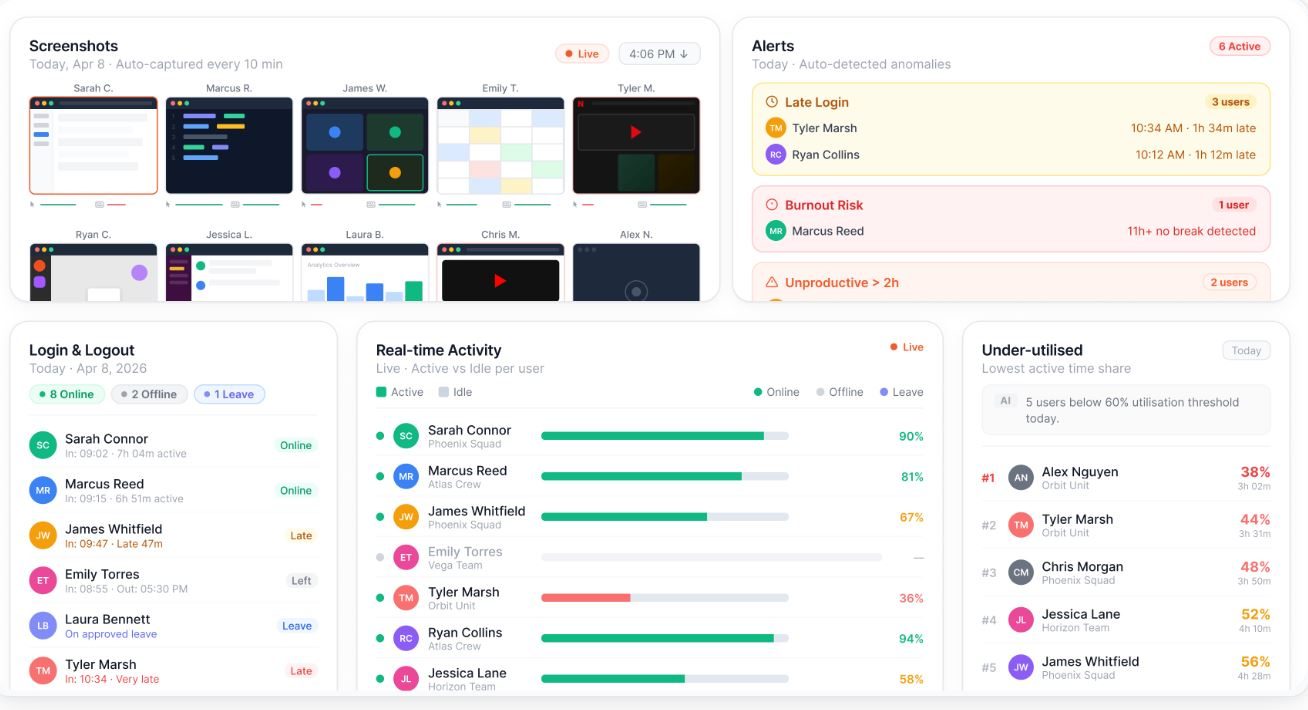
Success is measured by reduction in manager time spent on resource allocation decisions. The target is to reduce this time from about two hours per week to under 20 minutes. This happens as data replaces manual interpretation.
5. Identify and resolve performance blockers early
Identifying and resolving performance blockers early reduces delays caused by stalled work. Most blockers are discovered late in sprint retrospectives or quarterly reviews, by which time they have already slowed dependent tasks.
A structured weekly blocker review takes 15 minutes. It focuses on three questions. Who is currently blocked. What dependency is stopping progress. What decision from the manager is delaying work. Many blockers are caused by pending decisions rather than employee execution issues.
Research from SHRM, The Real Costs of Recruitment shows replacing an underperformer can cost between 50 percent and 200 percent of their annual salary, making early intervention critical for performance stability.
Success is measured by average time to resolve blockers. A healthy team resolves most blockers within 48 to 72 hours of identification.
6. Build an async-first communication rhythm
Building an async first communication rhythm also reduces unnecessary meetings and shifts routine communication to written updates.
Research from Harvard Business Review estimates that meetings consume roughly 15% of an organization’s time, with that figure rising to 35% for senior management.
The approach is to separate communication types based on urgency. Real time meetings are used only for decisions that require discussion. Updates, approvals, and status checks are handled asynchronously through tools like Slack or Teams.
A practical system includes a daily async standup with three updates: what was completed, what is being worked on, and what is blocked. Weekly sync meetings are reserved only for decisions that require discussion.
Success is measured by meeting hours per person per week. The target is under six hours for individual contributors and under ten hours for team leads.
7. Align employee goals with team goals weekly
Aligning employee goals with team goals weekly keeps individual work connected to overall team outcomes. Long term OKRs often lose relevance within a few months when they are not actively reinforced.
The approach is to add one weekly question during async standups asking how current work connects to the team goal. This takes five minutes and helps identify misalignment between daily tasks and intended outcomes.
If a team member cannot explain the connection, it indicates either unclear goals or misaligned work, which requires manager intervention.
Success is measured by the percentage of completed tasks that map directly to a team goal. The target is 80 percent or higher.
8. Use a performance improvement plan (PIP)
A performance improvement plan is a formal, structured process for addressing a documented and persistent output gap. It applies when an employee is consistently not meeting defined output expectations over time.
A PIP should only be used after clear expectations were set, feedback was given multiple times with time to respond, and blockers were reviewed and ruled out as the cause of poor output. Without these conditions, the plan is not appropriate.
A structured performance improvement plan includes the specific output gap in measurable terms. It includes improvement targets with deadlines using a 30/60/90 day structure. It includes a weekly check in cadence. It includes defined decision points at each stage. It is designed to track recovery, not immediately escalate to termination.
Success is measured by output improvement at 30, 60, and 90 days compared to the starting baseline. If improvement is visible the plan is working. If there is no improvement after 60 days with support in place, it signals a deeper role or fit issue.
Which performance strategy should you start with?
Start with the one that matches your current problem instead of trying to apply everything together.
Flowace helps teams understand how work actually happens by showing output, focus time, and blockers clearly. This makes it easier to identify the real issue instead of guessing which productivity fix to apply.
If you are an employee and want to increase output, start by defining your week in terms of clear results. If your work feels scattered or reactive, start by protecting focused time and reducing interruptions.
If you are a manager and your team is unclear on what success looks like, start by defining output expectations for each role. If you are managing based on visibility instead of real work performance, start by tracking work data to see actual patterns.
If you already have a consistent underperformer and clear expectations have been set with feedback and blocker checks, then a formal performance improvement plan (PIP) is the right next step.
Start with one area, apply it consistently, and review progress within two weeks before adding anything else.
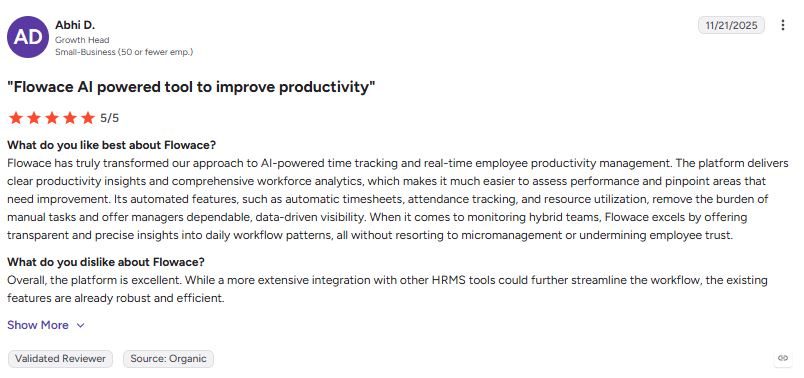
Review Highlight: Abhi D., Growth Head of small business with fewer than 50 people says Flowace gives managers clear visibility into productivity, time usage, and work patterns without relying on manual tracking. He highlights automated timesheets, attendance tracking, and workforce analytics as key features that make performance monitoring easier. He also notes that Flowace helps manage hybrid teams effectively while maintaining employee trust.
Ready to measure work performance consistently?
See all featuresFrequently asked questions on how to improve work performance
1. How can I improve my own work performance?
Start by defining your week in output terms instead of tasks. Then protect at least two hours of deep work per day, implement a 24-hour blocker escalation rule, and run a 15-minute Friday self-review. Each strategy gives you a specific metric so you know it’s working.
2. How do managers improve employee performance?
Effective managers do three things consistently. They set output based expectations so the team knows what done looks like. They give specific operational feedback on a weekly basis instead of waiting for formal reviews. They track performance using data instead of perception.
3. What are the best strategies to improve work performance?
The best strategies that produce the most measurable results are output-based goal setting, deep work time protection, frequent micro-feedback loops, and data-driven performance tracking. Each one works for both employees and managers.
4. What are the top 3 areas to improve work performance?
Top 3 areas to improve work performance are goal clarity, focus time, and feedback speed. Goal clarity defines work in measurable outputs instead of activities. Focus time protects uninterrupted work periods by reducing meetings and distractions. Feedback speed reduces the delay between performance signals and manager response.
5. How do you measure work performance improvement?
Work performance improvement is measured using output based metrics tracked weekly. The key metrics are task completion rate against goals, focus time per day, blocker resolution time, and percentage of tasks aligned to team goals. These indicators show whether work output is improving over time instead of just tracking activity.
6. What is a performance improvement plan for an employee?
A performance improvement plan (PIP) is a formal document that identifies a specific output gap, sets measurable improvement targets, and defines a timeline with check-in milestones typically 30/ 60/ 90 days. It is used after clear expectations have been set, specific feedback has been given, and blockers have been ruled out.
7. What’s the difference between work performance and productivity?
Work performance measures whether a person or team is achieving the outputs they were set against their goals. Productivity measures the ratio of output to input (time, effort, cost). High productivity with the wrong goals can still mean low performance. Performance is the more useful signal for managers.
8. How do I improve my performance review score?
You can improve performance review scores by maintaining a weekly log of completed outputs, deliverables, and resolved blockers. Use a 15-minute weekly self review to record measurable work throughout the year. At review time, present clear output evidence since reviewers score based on visible results.