Employee Monitoring Policy Template: 8 Must-Have Sections




Most monitoring rollouts go sideways for a simple reason: the tool shows up before the rules do. When the policy is vague, reactive, or missing entirely, employees hear about monitoring through rumors or a surprise pop-up. Trust takes the hit, and HR spends the next quarter cleaning up the fallout instead of improving outcomes.
This piece walks HR and Ops leaders through the sections an employee monitoring policy template needs to cover, why each one exists, and where teams tend to trip into trust-killing mistakes. The goal is a policy you can actually operate: built in layers, with clear intent, not a pasted checklist that collapses under the first hard question.
Before you read further, here is what matters most:
What Is an Employee Monitoring Policy (and What It Isn’t)?
An employee monitoring policy is the written agreement an organization makes with its employees about how workplace activity is observed. It defines what data is collected, the business purpose for collecting it, who can access it, how long it’s kept, and what rights employees have regarding their data.
One confusion shows up constantly: a monitoring policy is not the same as an acceptable use policy (AUP). The AUP sets expectations for how employees are allowed to use company systems. The monitoring policy explains how the company observes and records that use. There is overlap, but they solve different legal and operational problems. You need both, and they should reference each other rather than compete.
Create Your Monitoring Policy Today
A template gets you to a first draft; it does not get you to a shippable policy. You still have to tailor it to jurisdiction, workforce mix, and the specific tools you are deploying. What fits a 50-person SaaS company in Bengaluru does not automatically fit a 500-person BPO spread across multiple states. Reading the pros and cons of employee monitoring before you start drafting helps you set scope with eyes open.
Why You Need a Formal Policy Before You Deploy Any Tool
Deploying monitoring tools without a formal policy creates immediate legal, cultural, and operational risks.
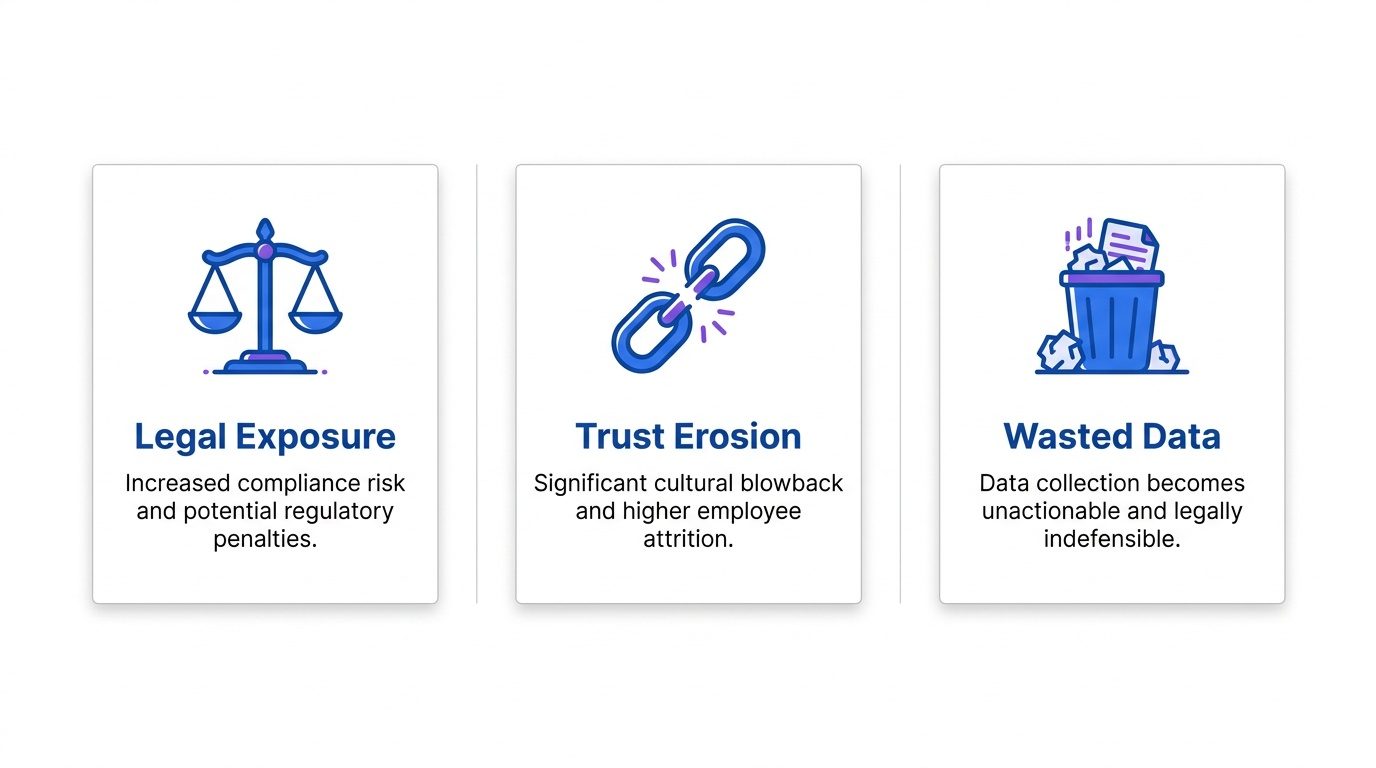
Skip the policy step and you tend to get the same three outcomes. One is legal exposure: GDPR fines, missteps under India’s DPDP Act 2023, or missing state-level notice requirements in the US. Enterprise deployment requires adherence to global standards like SOC 2 Type I, ISO, and HIPAA to ensure data integrity. The second is cultural blowback: trust erosion and attrition spikes that can dwarf any compliance penalty. The third is operational waste: collecting a pile of data that nobody can interpret, nobody is authorized to act on, and nobody can defend when challenged.
Consider a hypothetical scenario where a technology company introduces screen monitoring without advance communication. Within three weeks, the rollout could be dissected in Slack. Within a quarter, a significant portion of the engineering team might resign. The company would not have broken a law. It would have broken trust. Replacing those engineers would likely cost more than the annual monitoring contract by a factor of twenty.
The Monitoring Trust Stack: A 5-Layer Framework
A policy is more than a legal document; it’s a tool for building trust by answering employee questions proactively. The Monitoring Trust Stack is a framework for structuring your policy to earn employee confidence. Each layer builds on the one before it, moving from high-level intent to specific operational rules.
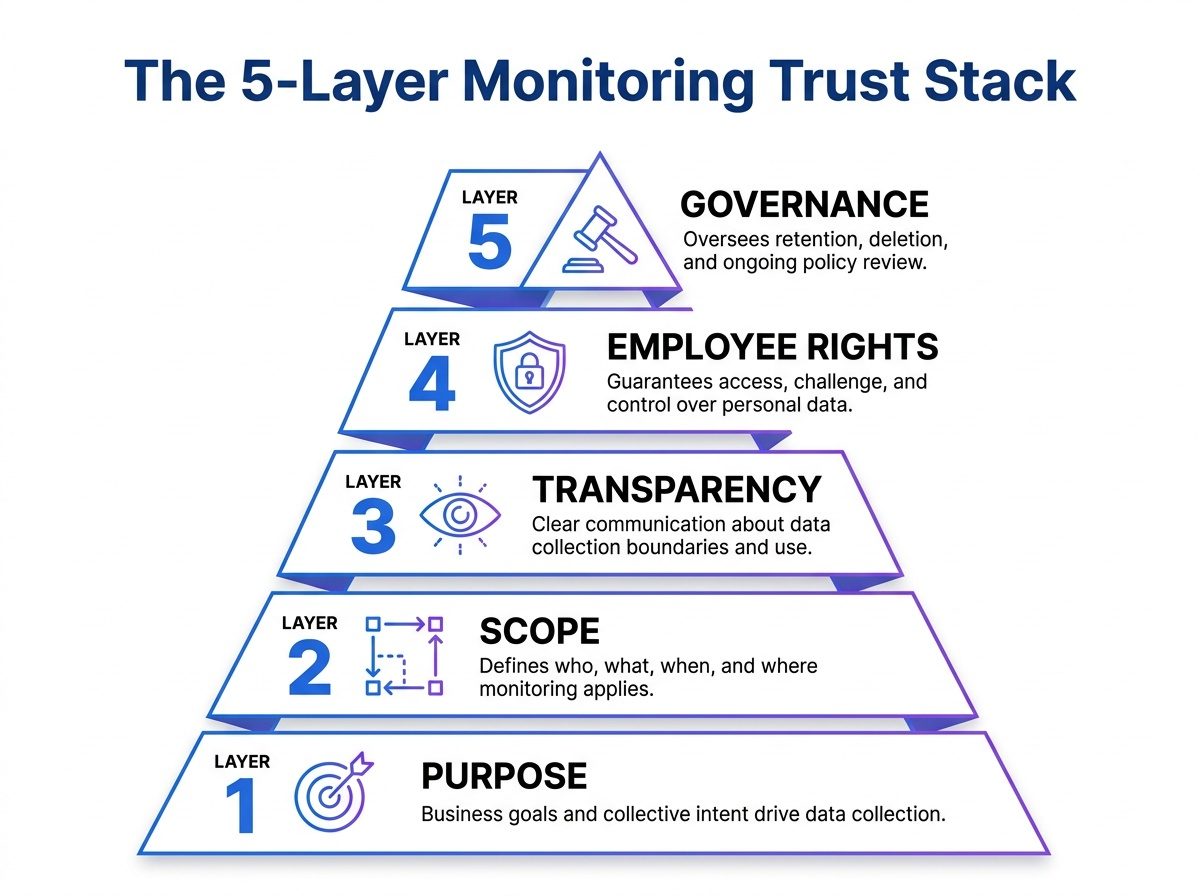
Organizations build trust by addressing each layer:
- Layer 1: Purpose. This is the ‘why’. It clearly states the business goals monitoring supports, such as improving team-level workflows or ensuring security. A strong purpose statement focuses on collective benefits, not individual surveillance.
- Layer 2: Scope. This defines the ‘who, what, when, and where’. It specifies which employees, devices, and applications are covered, and strictly limits monitoring to active work hours on company-owned assets.
- Layer 3: Transparency. This layer covers the ‘how’. It explains exactly what data is collected (and what isn’t), how it’s used, and who can access it. This is where you build credibility by being specific and setting clear boundaries.
- Layer 4: Employee Rights. This layer empowers employees. It outlines their right to access their own data, ask questions, and challenge inaccuracies without fear of retaliation. It turns monitoring from a one-way street into a two-way conversation.
- Layer 5: Governance. This is the ‘what’s next’. It establishes the rules for data retention, deletion, security, and policy review. This layer ensures the program is managed responsibly and adapts to new laws and organizational needs over time.
Discover Ethical Monitoring Features
The 8 Sections Every Employee Monitoring Policy Template Must Include
Treat these sections as the policy’s load-bearing walls. Each one answers a different question employees, managers, and counsel will ask the moment monitoring becomes real. Leaving a section out does not simplify the policy; it creates a gap that will surface at the worst possible time, forcing a reactive and inconsistent response.
Section 1: Purpose Statement
If you want one section that decides whether employees give you the benefit of the doubt, it is the purpose statement. People are not asking about your vendor. They are asking, plainly, “why are you watching me?” Legitimate purposes include productivity insights at the team level, security monitoring, compliance requirements, and resource planning. Purposes that predictably backfire include individual ranking without context, or treating monitoring data as the primary basis for discipline without corroborating evidence.
“The organization collects workforce activity data to understand team-level productivity patterns, ensure the security of company systems, and support operational planning. Data is not used to rank individual employees or as a standalone basis for performance evaluation.” Customize the details, but do not soften the ‘why’ into vague corporate language. Clarity is the point.
Section 2: Scope
Spell out who is covered (employees, specific roles, contractors) and what is covered (company-owned devices, specific systems, specific locations). BYOD is where otherwise reasonable policies tend to blow up. Personal devices usually require explicit, separate consent, and in several EU countries, off-hours monitoring on personal devices is outright illegal. Draw a bright line around active working hours versus off-hours. Off-hours monitoring is rarely defensible legally or ethically, and your policy should say that without euphemism.
Section 3: What Data Is Collected (and What Isn’t)
Be specific in both directions. The list of what you do not collect often does more to build trust than the list of what you do. Employees want boundaries they can understand and repeat. Here is a breakdown of common data types, their use cases, and the privacy risk each carries:
| Data Type | Business Purpose | Privacy Risk | Recommended Policy Treatment |
| Application & Website Usage | Understand software adoption, identify workflow bottlenecks, ensure focus on work-related tasks. | Medium. Can reveal personal browsing habits if not filtered. | Limit to work hours. Aggregate data at the team level. Allow employees to view their own data. |
| Active/Idle Time | Resource planning, workload balancing, identifying burnout risk. | Medium. Can be misinterpreted as ‘time-wasting’ without context. | Use for team-level insights, not individual performance evaluation. Combine with other metrics. |
| Screenshots/Screen Recording | Security investigations, training, compliance for specific regulated roles. | High. Captures sensitive information, personal messages, and passwords. | Disable by default. Use only for specific, disclosed investigations with a clear legal basis. Notify employee if possible. |
| Keystroke Logging | High-risk security investigations (e.g., data theft). | Very High. Captures all typed text, including passwords and private conversations. | Avoid entirely unless required for a specific, time-bound legal or security investigation. Requires clear legal justification. |
| Email/Chat Content | Legal discovery, compliance audits, HR investigations. | Very High. Accesses private and sensitive employee communications. | Prohibit access for routine monitoring. Access should require legal/HR approval for specific investigations only. |
Section 4: Data Access, Retention, and Deletion
Treat access as a policy choice, not a default setting. Can direct managers see individual-level data? Is HR limited to aggregate reporting? Do executives have full access, or only summaries? Decide it, write it down, and enforce it with role-based controls. GDPR Article 5(1)(e) also pushes you toward data minimization, including retention: keep data only as long as necessary. Many organizations retain monitoring data far longer than they can justify. Build deletion into the policy from day one: what happens when an employee leaves, and what happens when the retention window closes. Before you finalize this section, get clear on employee monitoring and data protection obligations so the policy matches your legal and operational reality.
The final four sections are where most templates get hand-wavy, but they are critical for building a policy that survives real-world edge cases.
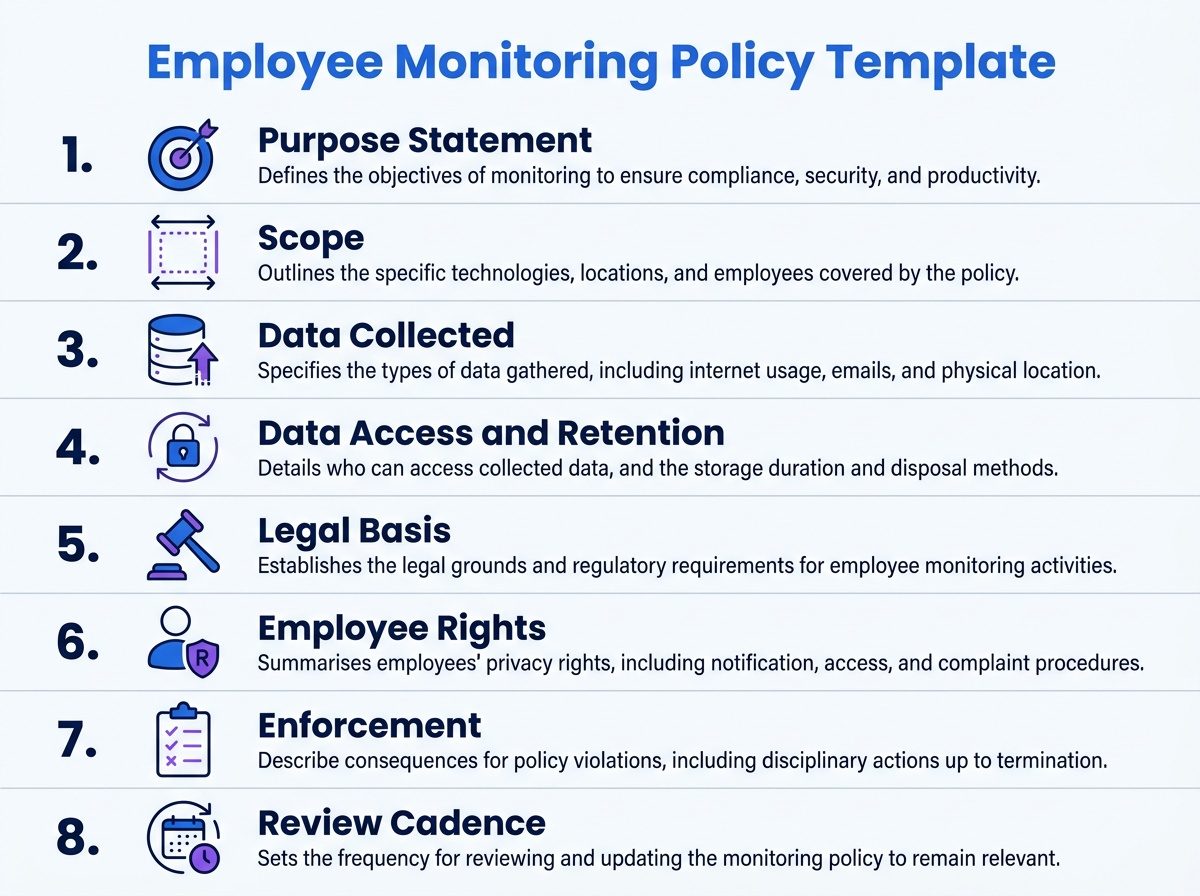
Section 5: Legal Basis
This section must state the specific lawful basis for data collection in each jurisdiction where you operate, such as under GDPR in Europe or the DPDP Act 2023 in India. For GDPR, this is often ‘legitimate interest,’ while in other regions it may be explicit consent. For enterprise deployment, ensuring your policy meets SOC 2 Type I, ISO, and HIPAA standards is critical for cross-border compliance.
Section 6: Employee Rights
Clearly outline the rights employees have regarding their data. This includes the right to access their own data, request corrections, and understand how it is used in performance assessments. Critically, it must also specify the process for raising concerns or filing complaints without fear of retaliation, naming a specific contact or department.
Section 7: Enforcement
Define what constitutes a violation of the monitoring policy and the consequences. This section should detail the process for investigating potential misuse of company assets or data discovered through monitoring. It’s also important to separate procedures for routine monitoring from those used in formal investigations to prevent scope creep.
Section 8: Review Cadence
A policy becomes outdated quickly. This section should name the policy owner (e.g., HR or Legal), mandate an annual review, and list triggers for an earlier review, such as entering a new jurisdiction or deploying a new tool. Including the next review date directly in the document ensures accountability.
What Most Teams Get Wrong About the Legal Section
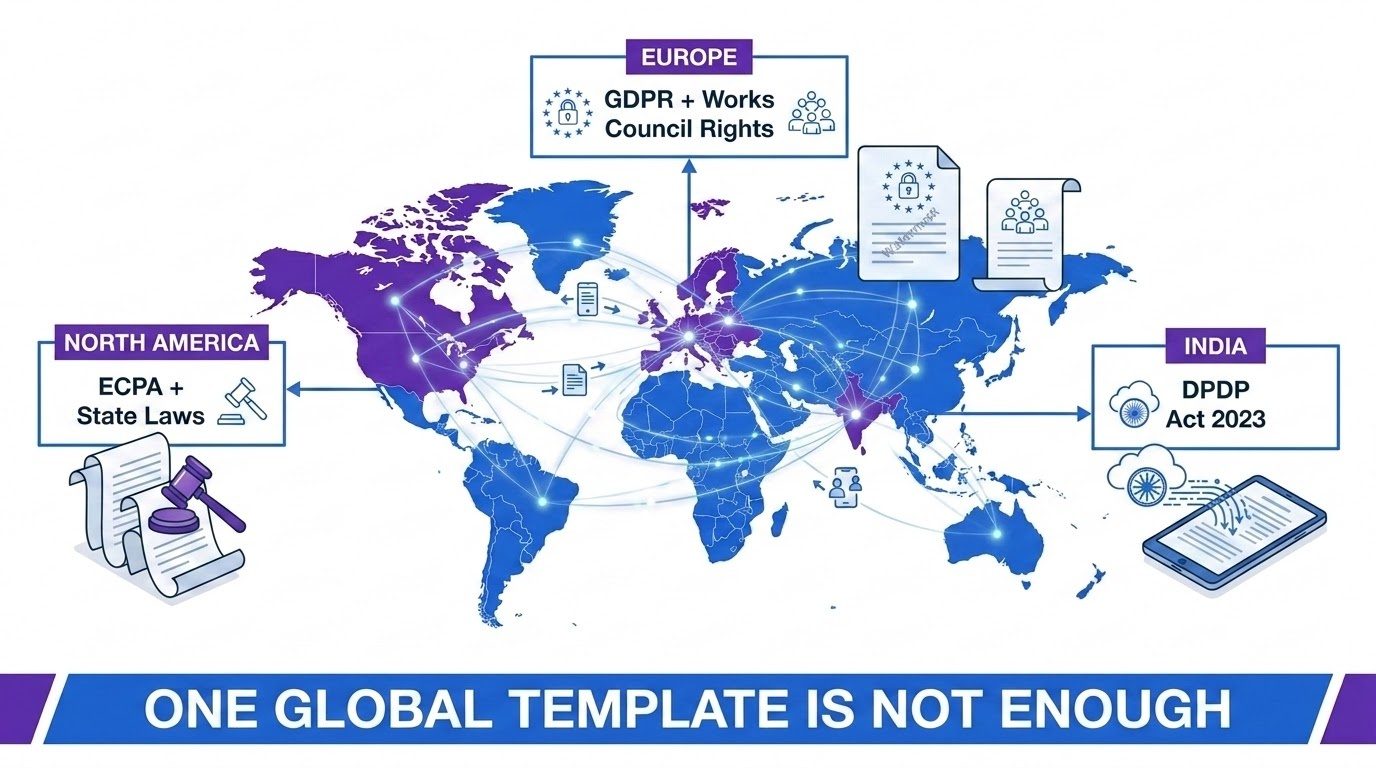
The most common legal mistake is assuming a US-centric template applies globally or specifically in India. Each jurisdiction has its own rules on consent, notice, and data subject rights. A policy that is compliant in one country can create significant liability in another, making a jurisdiction-by-jurisdiction review-balancing GDPR, HIPAA, and ISO requirements-essential before any global rollout.
Explore Enterprise Compliance Tools
Here is the high-level map of what matters. The US Electronic Communications Privacy Act (ECPA) generally permits monitoring on company-owned equipment for legitimate business reasons, but Connecticut and Delaware require written notice before monitoring begins. GDPR requires a valid lawful basis (often legitimate interest or explicit consent) and typically a Data Protection Impact Assessment before deployment. Canada’s PIPEDA requires informing employees about the nature and purpose of collection. India’s Digital Personal Data Protection Act 2023 adds new consent and data fiduciary obligations that India-based employers have to account for. If you need the jurisdiction-by-jurisdiction detail, the employee monitoring laws resource lays out each framework.
One trap is worth calling out because it shows up in so many drafts: “implied consent” via a handbook signature does not meet GDPR’s standard. Consent must be freely given, specific, informed, and unambiguous. When refusal risks someone’s job, “freely given” is hard to argue. That is why many GDPR-compliant monitoring programs lean on legitimate interest rather than consent, and why DPIA documentation is not optional paperwork, it is part of the defensibility story.
The practical recommendation is simple: have employment counsel in each operating jurisdiction review the policy before rollout. A template can accelerate drafting, but it cannot replace legal advice.
Employee Rights and the Transparency Clause
A policy’s credibility hinges on its transparency and the rights it grants employees. Workers should be able to see what is collected, request access to their own data, and challenge its use without retaliation. This is not just good practice; laws like GDPR and India’s DPDP Act 2023 mandate it.
The transparency clause is where intent becomes credible. It is the difference between “we track you” and “here is what we see, here is how we use it, and here is how you can challenge it.” Sample language: “Employees may request a summary of activity data held about them by contacting [HR contact]. Data is reviewed at the team level for operational planning and is not used as a standalone measure of individual performance. Employees who have questions about data collection or use may raise them with [designated contact] without risk of adverse action.”
If you are aiming for an ethical employee monitoring policy, treat transparency as a structural requirement, not a paragraph you tack on at the end to make the tone friendlier.
How to Roll Out the Policy Without Destroying Trust
A monitoring rollout is a change management exercise, not a quiet IT switch-flip. The policy document provides the rules, but the way you introduce it determines whether employees perceive it as a tool for support or for surveillance. The communication plan is as important as the policy itself, and it must be managed proactively.
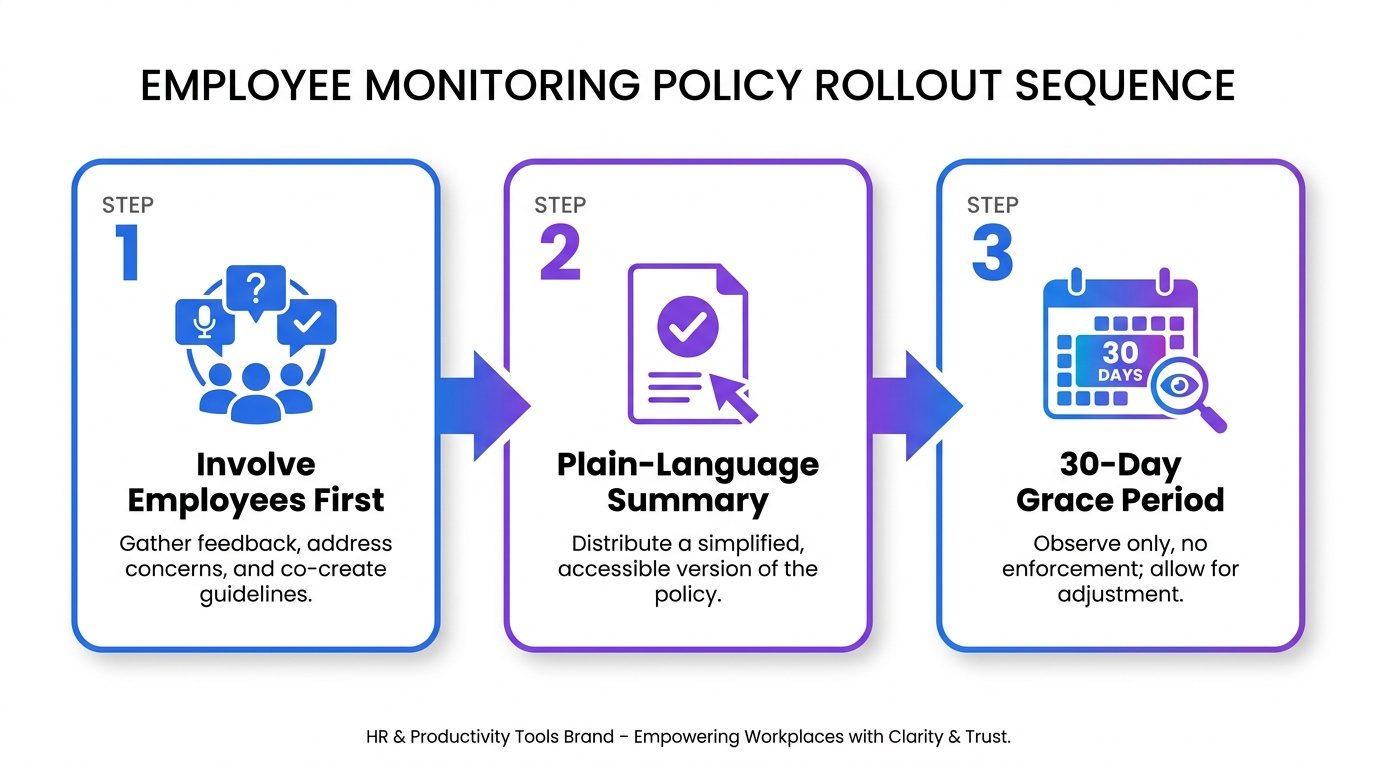
Step 1: Involve Employees Before Finalizing
Organizations that involve employees in policy development often experience smoother rollouts and higher acceptance because concerns are addressed before implementation. The point is not to hand over a veto. The point is to surface concerns early, tighten language that reads as punitive, and establish legitimacy before the tool goes live.
Step 2: Communicate in Plain Language
Publish a one-page, plain-language summary next to the full policy. Most employees will not read the long document, and pretending otherwise is how confusion spreads. Pair the written rollout with a live Q&A so managers and HR can answer questions in real time. An email with a PDF attachment is not a communications plan.
Step 3: Give a Grace Period Before Enforcement
A 30-day observation-only period, where you collect data but do not use it for performance or disciplinary action, gives people time to adjust and ask questions without fear. It also gives you a safe window to catch configuration problems. If the data is noisy or misleading, you want to learn that before it influences any decision.
Choosing a Monitoring Tool That Aligns With Your Policy
The most effective way to choose a monitoring tool is to let the policy lead the evaluation, not the other way around. A well-defined policy acts as a procurement checklist. If your policy prohibits screenshots or keystroke logging, you can immediately disqualify any product where those are core features. If it restricts data access to specific roles, confirming the tool has robust role-based access controls becomes a non-negotiable requirement before signing a contract.
Here is how the major tools in this space handle the policy-relevant features that tend to matter most:
Flowace helps HR and operations teams understand workload, focus, and capacity patterns across teams without relying on invasive monitoring practices. Key features include automated time tracking, application usage analytics, and project-based reporting, all of which can be configured to align with strict privacy boundaries. If your policy is built around context over control and team-level insight over individual scorecards, explore Flowace’s features to evaluate how it fits a transparency-first monitoring approach.
Advanced Considerations: Edge Cases That Will Come Up
The messiest problems usually come from what the template forgot to mention. These three scenarios surface regularly, and each one benefits from explicit language instead of improvisation. A strong policy anticipates these edge cases and provides clear guidance, so managers are not forced to make up rules under pressure.
Monitoring During PIPs and Investigations
Can monitoring become more intensive for someone on a performance improvement plan? Legally, often yes. Operationally, it needs to be disclosed upfront. When employees discover after the fact that monitoring increased during a PIP, grievance risk jumps. Keep routine monitoring separate from investigation-level monitoring in the policy to prevent scope creep and “special case” behavior that becomes the new normal.
Contractors, Freelancers, and Third-Party Workers
Contractors are not employees, and the same frameworks do not always apply. Your standard employee monitoring policy may not cover them cleanly. A common best practice is a separate addendum for non-employee workers that spells out consent, data handling, and scope. This matters even more for organizations in India that engage large contractor workforces through staffing agencies.
Cross-Border Teams and Jurisdictional Conflicts
A US-headquartered company with employees in Germany cannot simply export US monitoring norms. German works councils (Betriebsrat) have co-determination rights over monitoring practices. In practice, many organizations land on a base global policy with jurisdiction-specific appendices. That structure also makes updates easier: you can revise an appendix when local laws change without rewriting the entire policy. For remote teams working across borders, the guidance on how to monitor remote employees ethically goes deeper on the cross-border nuances.
The Review Cadence Nobody Builds In (But Should)
A monitoring policy is a living document that must adapt to changes in laws, technology, and business needs. Policies without a named owner and a scheduled review tend to go stale within 12 months. The best practice is to review the policy annually and any time a major organizational or regulatory trigger occurs.
Flowace’s workforce analytics dashboards can also help you audit whether your actual configuration matches what the policy claims. If the policy says you collect app usage and active time only, you should be able to confirm that in settings whenever you need to. Explore employee monitoring solutions that support this kind of policy-aligned setup.
Find the Right Balance: Explore Flowace’s Ethical Employee Monitoring Solutions
Employee Monitoring Policy Template: A Practical Starting Framework
Below is a structured outline for a complete policy template. Use it as the starting framework for your own document. Remember to tailor it to your organization’s specific context, secure legal review for each jurisdiction, and pair it with a thoughtful employee communications plan before any monitoring tools are deployed.
Template structure with placeholder guidance for each section:
- 1. Purpose Statement: State the specific business reasons for monitoring. Name the outcomes the data supports. Explicitly exclude punitive or ranking uses.
- 2. Scope: List which employees, roles, and device types are covered. Address BYOD separately. Specify active hours only.
- 3. Data Collected: List every data type collected. Include a ‘what we do not collect’ section. Reference the comparison table above.
- 4. Data Access and Retention: Define role-based access tiers. Set retention periods by data type. Document deletion protocols.
- 5. Legal Basis: State the lawful basis for each data type in each jurisdiction. Attach jurisdiction-specific appendices.
- 6. Employee Rights: Describe how employees can access their data, raise concerns, and opt out where legally permitted.
- 7. Enforcement: Define what constitutes a policy violation and the process for addressing it. Separate routine monitoring from investigation-level monitoring.
- 8. Review Cadence: Name the policy owner, set the annual review date, and list the triggers that require an out-of-cycle review.
If you want more help translating the policy into day-to-day operations, the employee monitoring best practices resource focuses on what “good” looks like once the policy exists and the tool is live.
What to Do This Week
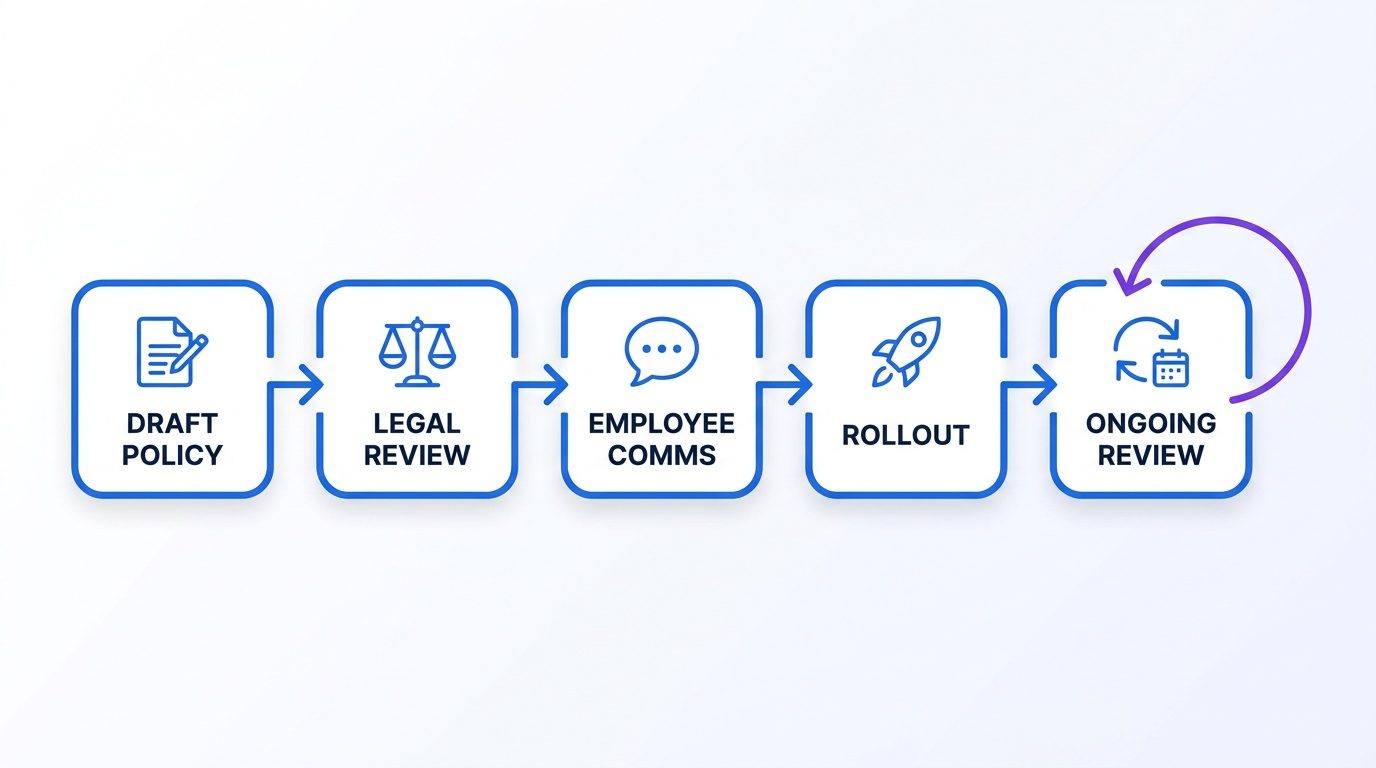
Three moves will do the most work immediately. Start by drafting the purpose statement first; it forces clarity on why monitoring exists and sets the tone for everything that follows. Next, get legal review before rollout, not after. A policy that has not been reviewed by employment counsel in each operating jurisdiction is not a safety net, it is a liability. Then treat employees like partners in the change: share the draft, run a Q&A, and set a grace period before enforcement begins.
A monitoring policy reads like compliance, but it functions like trust. Organizations that treat it as a trust document can create real visibility and accountability without stripping away respect. Organizations that treat it as paperwork tend to learn, expensively, that the cultural cost of getting it wrong is higher than the cost of doing it carefully.
Build Monitoring Policies With Trust
Start Free TrialFrequently Asked Questions on Employee Monitoring Policy Template
1. Is an employee monitoring policy legally required in India?
While not always explicitly mandated, you need an Employee Monitoring Policy Template to navigate India’s DPDP Act 2023 and global laws like GDPR safely. GDPR requires transparency, while in India, informed consent is paramount.
2. Can employees refuse to consent to workplace monitoring?
On company assets, rights are limited, but an Employee Monitoring Policy Template should clarify where consent or legitimate interest applies, especially for BYOD in India or under GDPR.
3. Should the employee monitoring policy template differ for remote vs. in-office workers?
Yes, remote work requires specific clauses in your Employee Monitoring Policy Template to handle home network data and flexible hours, particularly for cross-border teams in India and abroad.
4. How often should an employee monitoring policy be updated?
Update your Employee Monitoring Policy Template at least annually or whenever you deploy new tools or enter new markets like India to stay compliant with evolving regulations.
5. What is the difference between an employee monitoring policy and an acceptable use policy?
An AUP defines allowed behavior, while an Employee Monitoring Policy Template defines the observation rules. Both are essential for ethical management in India and globally.