Employee Productivity Monitoring in India



As an HR leader, you’re tasked with ensuring productivity. But how do you gain visibility into work patterns without eroding the very trust that fuels your culture? Effective employee productivity monitoring uses tools and data to understand how teams turn work hours into value. Done well, it gives you a clear view of capacity, focus, and workflow friction. This is about how Indian companies can implement monitoring that provides crucial visibility while strengthening, not damaging, the trust you’ve built with your teams.
Across Indian IT, BPO, and BFSI, hybrid work is the default. Leaders are under pressure to prove work is moving forward, while employees are wary of anything that feels like surveillance. That tension is real. As firms increasingly evaluate employee monitoring software in India, how you, as a People Ops leader, handle it will either strengthen your workplace or quietly corrode your culture. This article introduces a decision framework to help you get it right.
What HR and People Ops leaders need to know:
Employee Productivity Monitoring vs. Employee Surveillance
The most critical mistake leaders make is confusing monitoring with surveillance. For HR and People Ops, understanding how Employee Productivity Monitoring in India differs from intrusive tracking is the first step to building a healthy, high-visibility culture that retains top talent.
Employee productivity monitoring collects and analyzes work-pattern data, like time allocation and application usage, to see where productivity flows and where it gets stuck. The goal is to understand and improve work systems. It asks: “Are our teams set up for success and well-being?”
Employee surveillance tracks individual behaviors in real time, often using keystroke logging, screenshots, or webcam feeds. The goal is to watch specific people. It asks: “Is this person working right now?”
| Dimension | Productivity Monitoring (Visibility for HR) | Employee Surveillance (Control) |
| Primary Goal | Improve team effectiveness, balance workloads, and identify systemic workflow issues. | Police individual activity, enforce rules, and track real-time behavior. |
| Core Question | Where is our time going? Are we at risk of burnout? | What is this person doing right now? Are they active? |
| Data Focus | Aggregated, team-level patterns (e.g., meeting load, focus time, after-hours work). | Individual, real-time actions (e.g., keystrokes, screenshots, web history). |
| Typical Output | Dashboards showing workload balance, burnout risk, and focus trends. | Activity timelines, screen captures, idle-time alerts. |
| Impact on Trust | Builds trust when transparent; seen as a supportive management tool for employee well-being. | Erodes trust; creates anxiety, hurts retention, and leads to a culture of fear. Research consistently shows electronic monitoring is associated with increased work stress and lower job satisfaction. |
| Legal Risk (DPDP Act) | Lower risk; aligns with data minimization and purpose limitation. | Higher risk; often collects excessive data without a clear, limited purpose. |
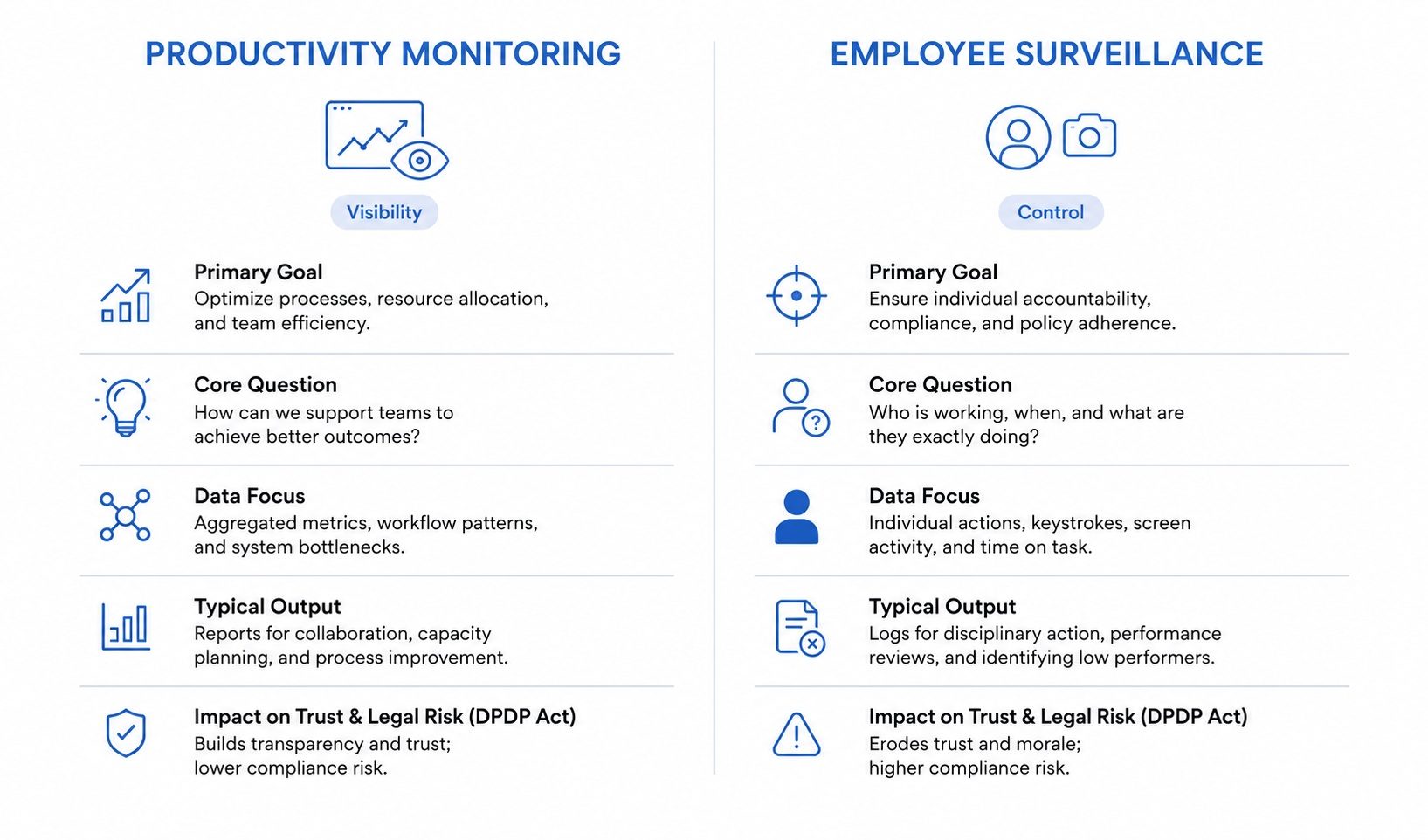
One path leads to operational insight and a healthier work environment; the other leads to a culture of distrust and performative work. PwC’s 2025 Global Workforce Hopes and Fears Survey found that employees with the highest levels of psychological safety were 72% more motivated than those with the lowest levels (PwC). Surveillance directly undermines that safety, impacting engagement and retention.
Why Are Indian Organizations Adopting Productivity Monitoring Now?
India’s wrinkle is scale and complexity. Large teams and a relationship-driven culture don’t map neatly onto remote work. A manager who once gauged team energy by walking the floor now has no equivalent signal. For HR leaders, implementing effective Employee Productivity Monitoring in India is crucial to remove blind spots around burnout risks, uneven workloads, and engagement dips that can precede attrition.
Get monitoring wrong and you lose talent. According to the American Psychological Association’s 2023 Work in America Survey, 45% of monitored workers reported that workplace monitoring negatively affected their mental health. Skip monitoring entirely and you operate blind, unable to spot burnout before it’s too late. Neither is a good option for a people-first organization.
How Can Indian HR Leaders Balance Productivity Monitoring and Trust?
Most monitoring programs fail because leaders choose a tool before they choose a philosophy. The Trust-Visibility Framework helps you evaluate any approach before rollout. It uses two axes: the granularity of the data (Team-Level vs. Individual-Level) and the transparency of the program (Disclosed vs. Covert).
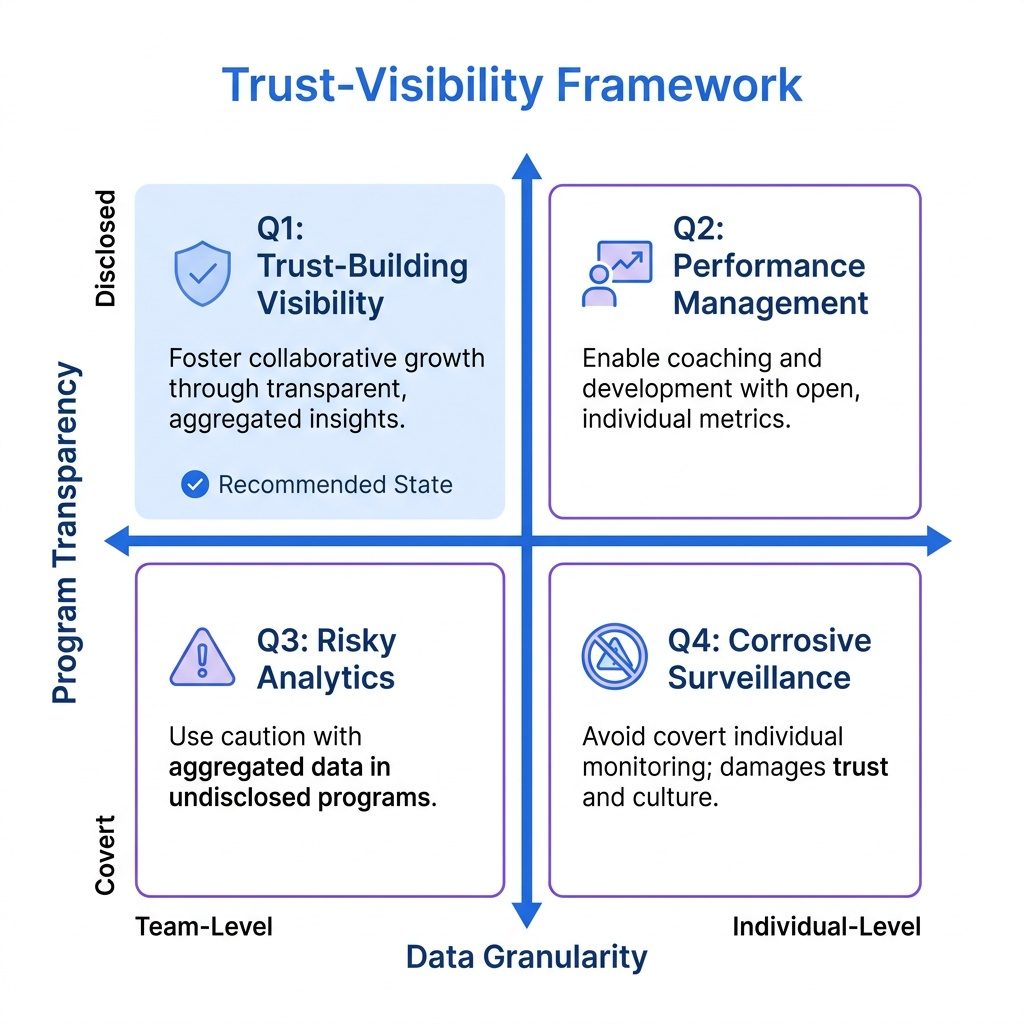
The four quadrants and what they mean for Indian organizations:
Ready to surface your hidden productivity leaks? See how Flowace works.
- Quadrant 1: Disclosed + Team-Level (Trust-Building Visibility). This is the ideal state for HR and People Ops. Employees know monitoring exists, and insights are aggregated at the team level. The focus is on improving systems, balancing workload, and preventing burnout, not scoring individuals. This is Flowace’s default philosophy.
- Quadrant 2: Disclosed + Individual-Level (Performance Management). This can be effective for coaching or performance reviews, but only when the employee knows what’s measured and has access to their own data. It requires high trust, clear communication, and strong governance from HR.
- Quadrant 3: Covert + Team-Level (Risky Analytics). This sits in a legal grey area under the DPDP Act and is culturally dangerous. Employees inevitably discover the monitoring, leading to a catastrophic loss of trust that HR will have to manage. Avoid this.
- Quadrant 4: Covert + Individual-Level (Corrosive Surveillance). This is legally risky and culturally toxic. It communicates total distrust and is a direct path to attrition, especially when deploying employee monitoring software India without transparency.
How to Use the Framework: A Decision Checklist for HR Leaders
- Assess Your Current State: Where does your current (or planned) approach sit? Be honest. If you are using hidden tools or tracking individual activity without a clear, communicated purpose, you are in Quadrant 3 or 4.
- Define Your Goal: Is your goal to improve team well-being and workflow (Q1) or manage individual performance (Q2)? If it’s to ‘catch people slacking,’ your problem is culture or hiring, not a lack of monitoring.
- Check for Warning Signs: Are employees anxious about being watched? Is ‘looking busy’ becoming more important than actual output? These are signs you’re drifting toward surveillance and creating a culture of fear.
- Plan Your Implementation: Start in Quadrant 1. When rolling out Employee Productivity Monitoring in India, announce the program, explain the ‘why’ from a people-first perspective, and focus on team-level insights.
- Flowace Example: Flowace is designed for Quadrant 1. It provides HR leaders with team-level analytics on focus, meetings, and workload without resorting to screenshots or keystroke logging. You see workload distribution across the team, not whether one engineer was idle at 2:37 PM. This makes it a tool for improving work, not policing people.
For most Indian companies, the only safe operating zone is Quadrants 1 and 2. Transparent monitoring programs are consistently associated with higher trust and acceptance than covert monitoring because employees understand what data is collected and why it is being used. Transparency isn’t just ethical; it’s the pragmatic choice for retaining talent.
The Visibility Ladder: A Maturity Model for Workforce Analytics
Effective monitoring isn’t a single action; it’s a journey up the Visibility Ladder. Each level provides deeper insight, moving from basic activity to predictive analytics that can inform HR strategy. This proprietary Flowace model helps leaders understand what question they can answer at each stage.
Get more visibility into your team’s workload with Flowace
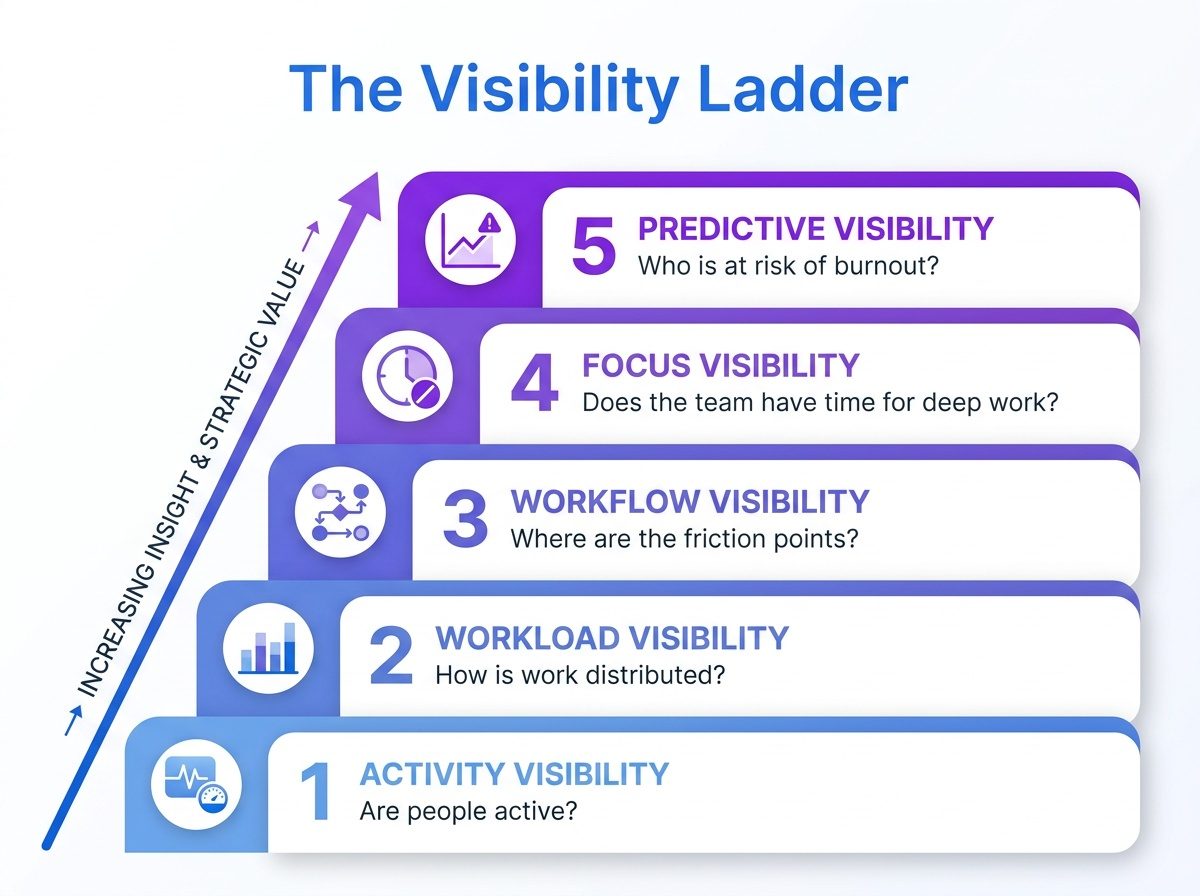
- Level 1: Activity Visibility. The Question: Are people active? This is the most basic level, tracking simple online/offline status. It offers very little insight and is often where surveillance tools stop.
- Level 2: Workload Visibility. The Question: How is work distributed? This level analyzes time allocation across projects, revealing who is overloaded and who has capacity. This is a key input for load balancing.
- Level 3: Workflow Visibility. The Question: Where are the friction points? By analyzing application usage and meeting patterns, you can spot inefficiencies like excessive tool-switching or meeting overload that frustrate employees.
- Level 4: Focus Visibility. The Question: Does the team have time for deep work? This measures uninterrupted blocks of time, a key leading indicator of productive output and employee satisfaction for knowledge workers.
- Level 5: Predictive Visibility. The Question: Who is at risk of burnout? By combining these signals over time, advanced platforms can identify patterns (like consistent after-hours work) that predict burnout or attrition risk, allowing HR to intervene proactively.
Most organizations get stuck at Level 1, which offers minimal value. The goal for strategic HR is to climb the ladder to gain more valuable insights into team health and retention risks through robust Employee Productivity Monitoring in India. Flowace is designed to help teams operate at Levels 2, 3, and 4, turning data into actionable signals for People Ops.
See workload, focus, and capacity clearly with Flowace.
How Does Employee Productivity Monitoring Actually Work?
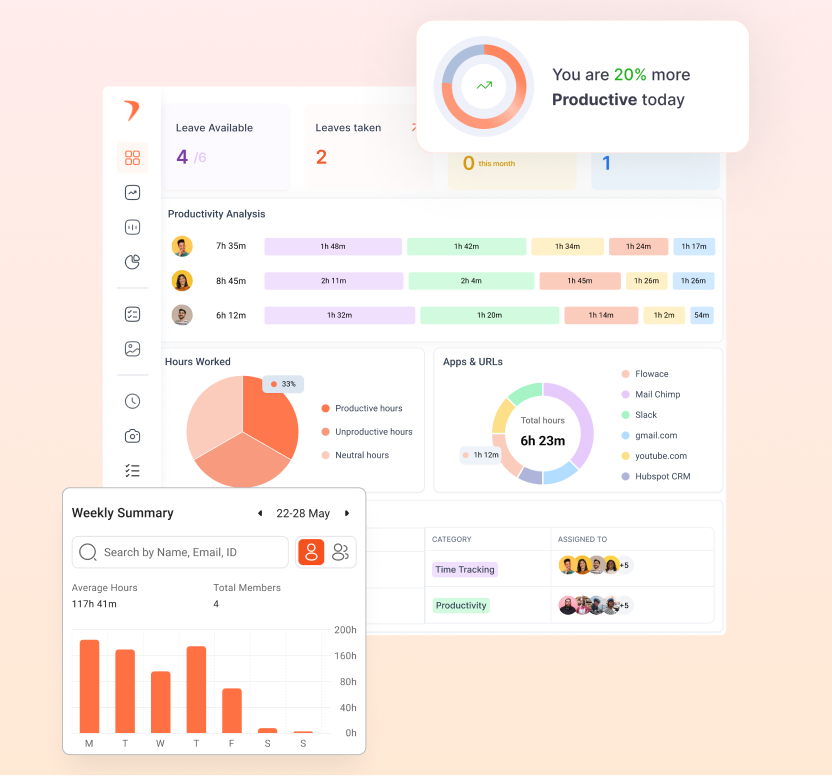
Modern productivity platforms collect work-pattern metadata, such as application usage, meeting load, and focus duration. They then surface aggregated insights in dashboards for managers and HR leaders, rather than raw activity feeds. An agent or integration captures this metadata and rolls it up to the team level, presenting trends that can be used to make decisions about resources, processes, and well-being.
What Gets Measured (and What Shouldn’t)
The signals that improve decisions are structural: how time spreads across tasks, the ratio of deep work to fragmented time, and trends in after-hours work. These tell you if the system is healthy and sustainable for your employees.
The signals that damage trust are personal: keystroke logging, random screenshots, and constant webcam monitoring. They produce mountains of low-value data and send one message: “We don’t trust you.” This is a recipe for attrition.
A First-Party Insight from Flowace
Based on observations from organizations using workforce analytics, one recurring pattern is meeting overload masquerading as low productivity. Teams appear busy, logging long hours, but output stalls. The data often reveals that a significant portion of the work week is consumed by meetings, leaving insufficient time for focused execution. This isn’t a problem of employee effort; it’s a problem of calendar culture. Without visibility into this pattern, leaders often misdiagnose the issue as disengagement, when the real culprit is a broken workflow that is burning people out.
How to Choose the Right Employee Productivity Monitoring Tool
A tool’s philosophy matters more than its feature list. For Indian HR leaders, the right choice depends on your primary use case and commitment to building a high-trust culture. Use this decision matrix to guide your selection.
| Use Case | Recommended Tool Category | Key Considerations for HR | Flowace’s Approach |
| Project Billing & Freelancers | Manual Time Trackers | Simple, but relies on self-reporting and has high admin overhead. Prone to errors. | Flowace offers automated time tracking to reduce manual entry for project costing. |
| Contractual Output Verification (e.g., BPO) | Activity Monitoring Tools | Provides ‘proof of work’ with screenshots but carries a very high trust cost and legal risk under the DPDP Act. | Not Flowace’s focus. We believe this model is corrosive to trust and psychological safety. |
| Hybrid Team Productivity & Well-being | Workforce Analytics Platforms | Focuses on team-level patterns, workload balance, and burnout signals. Best for building trust and ensuring DPDP compliance. | This is Flowace’s core. We provide visibility into focus, meetings, and capacity without surveillance. |
| Insider Threat & Security | User Behavior Analytics (UBA) | Highly specialized for security, not HR. Often deployed covertly for compliance reasons. | Flowace is a productivity and well-being tool, not a security surveillance system. |
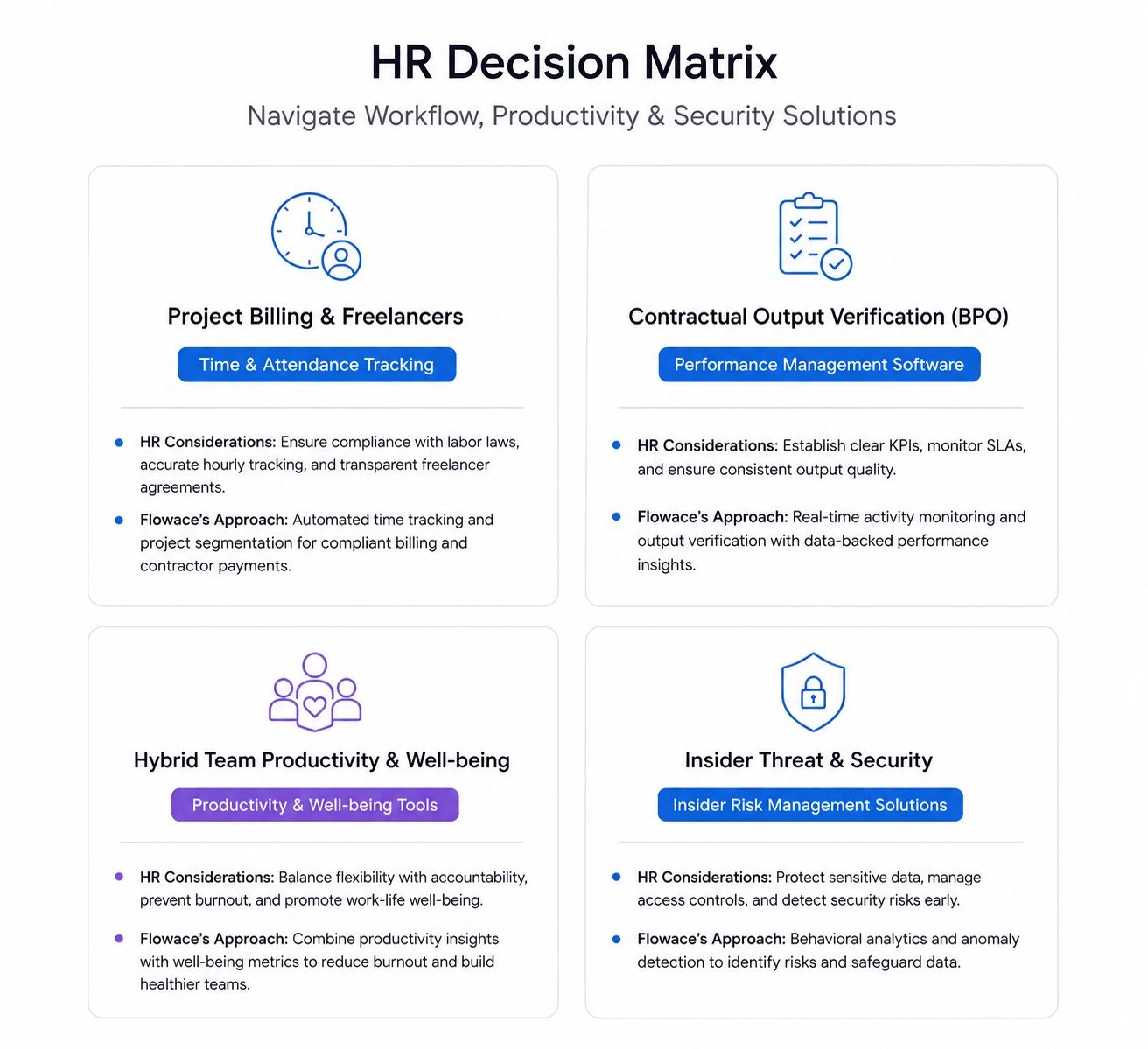
For most Indian knowledge-work organizations, a workforce analytics platform is the correct choice for HR. It delivers the necessary visibility for managing hybrid teams without defaulting to surveillance. If you’re evaluating employee monitoring software India, start by clarifying your use case and filtering by philosophy.
How Are Indian Companies Getting This Right (and Wrong)?
The success stories focus on outcomes and systems. Several large Indian technology organizations have shifted toward outcome-based metrics for hybrid teams. Instead of tracking hours, the focus moves to deliverables and milestones, a change publicly framed around trust and flexibility. This gives managers visibility into output without normalizing surveillance.
The failure mode is common when intrusive monitoring is deployed without transparency. Research consistently shows that intrusive monitoring practices are associated with higher stress, lower job satisfaction, and reduced employee trust, landing squarely in Quadrant 4 of the Trust-Visibility Framework. The talent retention cost can be immense.
For a concrete example, take a mid-tier chartered accountancy firm that struggled with invisible timesheet gaps. By deploying Flowace, they uncovered that administrative overhead and internal meetings were silently consuming 15-25 hours of potential client-billable time every month per employee. With this data, leadership didn’t need to guess or add headcount; they redistributed internal workloads, recovered thousands of billable hours, and improved staff retention by preventing burnout. The data solved a system-level problem, not an individual one.
Three Misconceptions About Employee Productivity Monitoring
Misconception 1: More data equals more productivity. Over-monitoring often creates productivity theater, where employees optimize for looking busy rather than for achieving outcomes. The goal is not to collect more data, but to answer better questions about team capacity and workflow friction. True productivity comes from insight, not just oversight.
Misconception 2: Monitoring is only for remote teams. Office presence was never a reliable proxy for productivity or well-being. The visibility gaps that lead to burnout and attrition exist in every work model. The real challenge is understanding workload and focus, regardless of location.
Misconception 3: Indian law permits any monitoring on company devices. The Digital Personal Data Protection Act 2023 significantly changes this. It introduces data minimization, purpose limitation, and notice obligations that make blanket, undisclosed monitoring legally risky. HR leaders must ensure compliance to avoid penalties.
How to Roll Out Monitoring Without a Trust Crisis
Step 1: Define the problem you are solving. Start with a business question from an HR perspective, like, “Are our teams overloaded?” or “Do we have enough focus time to prevent burnout?” If the goal is just to “make sure people are working,” you are already on the path to surveillance.
Step 2: Choose transparency. Announce the tool, explain what it collects (and what it doesn’t), and give employees access to their own data. Transparent monitoring is not just ethical, it is more effective for building a culture of trust.
Step 3: Start with teams, not individuals. Begin with team-aggregate insights (Quadrant 1). This builds trust and demonstrates the value of the data for improving systems and well-being. For a practical sequence, our guide on how to monitor remote employees ethically breaks down the rollout.
Step 4: Create a written policy. Document what is collected, who sees it, and what it is used for. Align the policy with DPDP Act 2023 requirements. If data will inform performance reviews, that process needs clear governance from HR to avoid legal and cultural blowback. Using monitoring data in performance reviews requires careful handling.
Build high-trust productivity visibility with Flowace.
The Strategic Choice: Visibility or Surveillance?
For Indian HR leaders, implementing employee productivity monitoring is no longer a question of ‘if’ but ‘how.’ The shift to hybrid work, combined with new data privacy laws, has raised the stakes. Done thoughtfully, it is a powerful tool for building a better, more supportive workplace. Done poorly, it is a self-inflicted wound to your culture and employer brand.
The choice is not between monitoring and no monitoring. It is between visibility and surveillance. Visibility empowers you to remove roadblocks, balance workloads, and protect your teams from burnout. Surveillance creates a culture of fear and performative work, ultimately undermining the very productivity it claims to measure. By adopting a transparent, team-first approach, you gain the insights you need to lead effectively and build a workplace where people can thrive.
Improve employee productivity without complexity
Start Free TrialFrequently Asked Questions on Employee Productivity Monitoring
1. Is employee productivity monitoring in India legal under the DPDP Act 2023?
Yes, Employee Productivity Monitoring in India is permissible with a legitimate business purpose. However, the Digital Personal Data Protection Act 2023 adds key requirements: employers must provide notice, collect only necessary data, and use it only for the stated purpose. Covert monitoring is legally risky; a written policy aligned with the DPDP Act is essential.
2. What is the difference between employee monitoring and employee surveillance in Employee Productivity Monitoring in India?
Employee monitoring analyzes aggregated work patterns, such as time allocation and tool usage, to improve team workflows and capacity planning. Employee surveillance tracks individual, real-time behaviors, such as keystrokes and screenshots, to police activity. Monitoring seeks to improve systems and support people; surveillance seeks to control them.
3. How do you monitor remote employee productivity monitoring in India without screenshots?
Effective Employee Productivity Monitoring in India can be achieved using a workforce analytics platform like Flowace. These tools collect passive metadata about work patterns, such as application usage, focus time, and meeting load, without capturing invasive details like screenshots or keystrokes, respecting employee privacy while providing actionable team trends.
4. Should employees have access to their own productivity data?
Yes, absolutely. Providing employees access to their own data is critical for building trust and transparency. It reframes monitoring from a tool of control to a tool for self-improvement. It also aligns with the principles of the DPDP Act 2023 and can increase employee acceptance of monitoring programs.
5. What metrics should Indian HR leaders track for hybrid teams using employee monitoring software India?
For HR and People Ops, focus on structural metrics that reveal team health and burnout risk. Key metrics include:
- Focus time: Measures uninterrupted deep work.
- Meeting load: Identifies meeting overload.
- Workload distribution: Reveals team imbalances.
- After-hours work: Indicates burnout risk.
- Capacity utilization: Supports resource planning.